
Whether you are building a short teacher-training workshop, a school program or a full online course, good course design makes the difference between content that is “covered” and learning that actually happens. This guide walks you through a proven process: start with the end in mind, write clear outcomes, align activities and assessment, and check quality before you launch.
What good course design looks like
Well-designed courses share a few features: learners know what they will be able to do and why it matters; activities give plenty of practice and feedback; assessment checks the outcomes that were promised; and the course is easy to navigate and accessible to everyone. The Quality Matters rubric, widely used for online and blended courses, organizes these into eight general standards, from course overview and learning objectives to accessibility and usability (Quality Matters).
Step 1: Analyze your learners and context
Who are the learners? What do they already know? Why are they taking the course? How much time do they have, and on which devices will they study? A short survey or a few interviews before you design will save many hours later.
Step 2: Start with the end in mind (backward design)
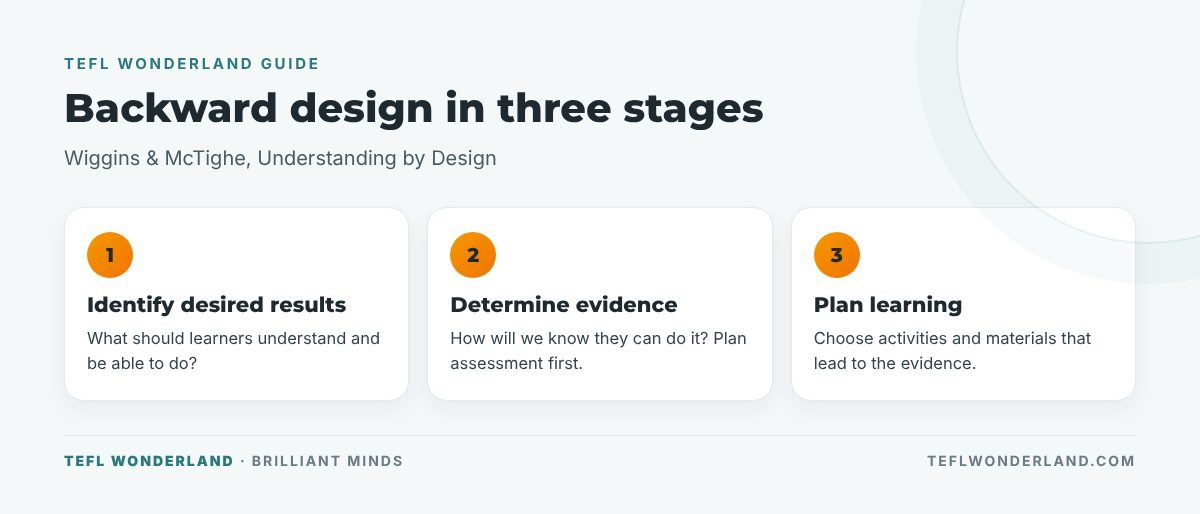
In Understanding by Design, Grant Wiggins and Jay McTighe describe backward design: first decide the results you want, then decide what evidence will show learners have reached them, and only then plan the learning activities (Wiggins & McTighe, 2005). It sounds obvious, but many courses are designed the other way around: starting with content and adding a test at the end.
Step 3: Write clear learning outcomes
A good outcome describes what learners will be able to do, in observable terms:
- Weak: “Understand classroom management.”
- Strong: “Plan routines and instructions for the first lesson with a new class.”
Bloom’s revised taxonomy offers useful verbs at different levels of thinking, from remember and understand to apply, analyze, evaluate and create (Anderson & Krathwohl, 2001). Aim for a mix, with plenty of apply and create for professional courses.
Step 4: Align activities and assessment
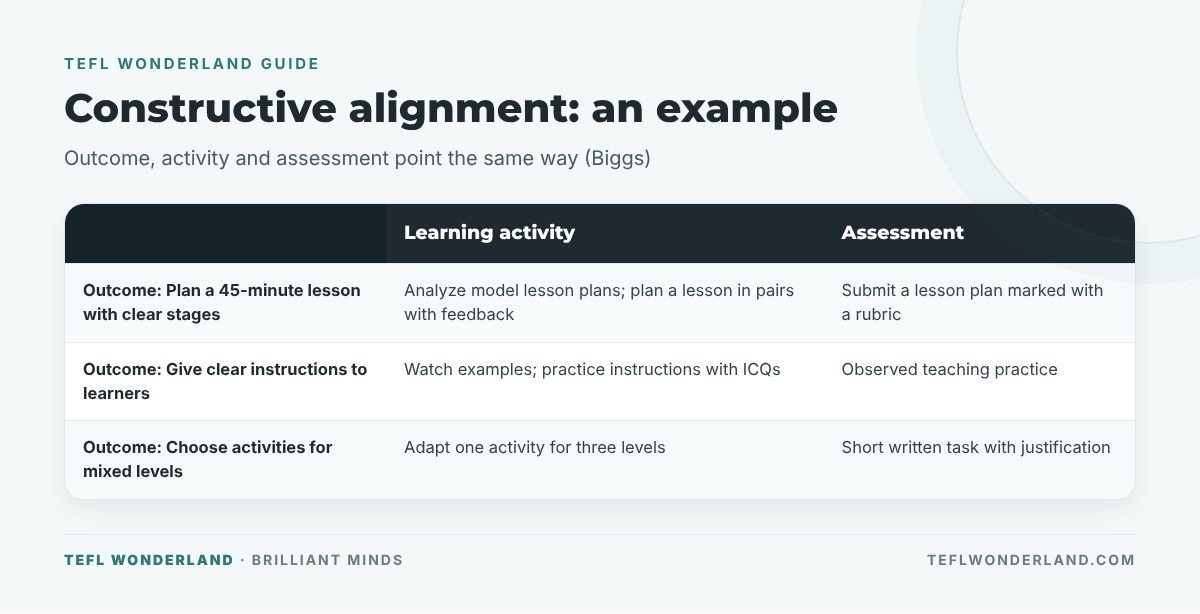
John Biggs called this constructive alignment: the outcomes, the learning activities and the assessment tasks should all point in the same direction (Biggs, 1996). If the outcome is “plan a lesson”, learners should practice planning lessons and be assessed on a lesson plan, not on a multiple-choice quiz about lesson planning theory.
Step 5: Design engaging learning activities
M. David Merrill’s First Principles of Instruction suggest that learning is most effective when it is centered on real-world problems and when learners activate prior knowledge, see demonstrations, apply new skills and integrate them into their own work (Merrill, 2002). In practice:
- Start with a real task or problem, not with theory.
- Show examples and models before asking learners to try.
- Give practice with feedback, from guided to independent.
- Ask learners to apply what they learned to their own context.
Step 6: Structure the course
Break the course into modules or units with a clear sequence. Each unit should have an outcome, a short introduction, learning materials, practice activities and a checkpoint. In our own courses we use a gamified map of zones and territories, so learners always see where they are and what comes next; gamification can add motivation when it supports clear goals.
Step 7: Choose materials and media
Use a mix of short videos, readings, interactive practice and real examples. Keep videos short and focused. Make sure every resource has a purpose linked to an outcome, and remove anything that doesn’t.
Step 8: Make it accessible from the start
Captions for videos, readable fonts and colors, clear headings, alternative text for images and flexible ways to show learning help everyone, not only learners with disabilities. Universal Design for Learning (UDL) gives a practical framework for this.
Step 9: Pilot, evaluate and improve
Test the course with a small group, collect feedback and data, and improve it. Kirkpatrick’s four levels (reaction, learning, behavior and results) are a useful way to evaluate training courses (Kirkpatrick Partners).
Course design checklist
- Clear, observable outcomes for the course and each unit
- Assessment planned before activities, and aligned with outcomes
- Practice with feedback in every unit
- Clear navigation and instructions
- Accessible materials (captions, alt text, readable design)
- A plan to collect feedback and improve
Learn course design with us
Our Train the Trainer certification covers adult learning, engagement and instructional design for people who design and deliver training. In our teacher development courses you’ll also find Planning Lessons and Designing Teaching Materials and Integrating AI and Authoring Tools for Enhanced Teaching, Assessment, and Administrative Efficiency.
FAQs
What is the difference between course design and instructional design?
The terms overlap. Course design usually refers to planning a specific course; instructional design is the wider field and process of designing learning experiences.
How long does it take to design a course?
It depends on length and format. A short workshop may take a few days; an online course with videos and interactive activities can take weeks or months. Backward design saves time by focusing effort on what matters.
Do I need special software for online course design?
Not to start. A clear plan comes first; tools such as learning management systems and authoring tools then help you build and deliver it.
References and further reading
- Wiggins, G., & McTighe, J. (2005). Understanding by Design (expanded 2nd ed.). ASCD.
- Biggs, J. (1996). Enhancing teaching through constructive alignment. Higher Education, 32(3), 347–364. doi.org/10.1007/BF00138871
- Merrill, M. D. (2002). First principles of instruction. Educational Technology Research and Development, 50(3), 43–59. doi.org/10.1007/BF02505024
- Anderson, L. W., & Krathwohl, D. R. (Eds.). (2001). A Taxonomy for Learning, Teaching, and Assessing. Longman.
- Quality Matters. Higher Ed Course Design Rubric. qualitymatters.org
- Kirkpatrick Partners. The Kirkpatrick Model. kirkpatrickpartners.com