
Teachers are interested in the brain, and for good reason: learning is a change in the brain. But the popularity of “brain-based” teaching has also spread many myths. This guide explains what the neuroscience of learning and cognitive science can genuinely tell teachers, how to turn it into classroom practice, and which popular claims the evidence does not support.
What the neuroscience of learning can and can’t tell teachers
Neuroscience studies the brain at the level of neurons, networks and brain regions. Most direct classroom advice comes from cognitive psychology, which studies memory, attention and learning through behavior. Together they form what some call the “science of learning”. Paul Howard-Jones, a leading researcher in educational neuroscience, warns that the gap between lab findings and classroom practice is large, and that misunderstandings easily turn into myths (Howard-Jones, 2014).
So when you read about the neuroscience of learning, the useful questions are: What is well supported by research? And what is it reasonable to try in class?
1. Learning changes the brain
Every time we learn, connections between neurons strengthen or change; this is called neuroplasticity. The practical message is encouraging: abilities are not fixed, and practice changes the brain throughout life. The OECD’s report Understanding the Brain: The Birth of a Learning Science (2007) summarizes this for educators.
2. Retrieval strengthens memory
Remembering something, by trying to recall it without looking, strengthens memory more than simply rereading it. In a classic study, students who practiced recalling a text remembered much more a week later than students who reread it (Roediger & Karpicke, 2006). Use low-stakes quizzes, “brain dumps”, flashcards and quick reviews at the start of lessons.
3. Spacing beats cramming
Studying the same material in several shorter sessions spread over time leads to better long-term memory than one long session. A large review of studies confirmed this spacing effect across many conditions (Cepeda et al., 2006). Plan reviews after a day, a week and a month.
4. Working memory is limited
We can only hold a small amount of new information in mind at once. Cognitive load theory suggests teachers should present new material in small steps, use worked examples and avoid unnecessary information on slides (Sweller, 1988). This is especially important for language learners, who are processing a new language at the same time.
5. Sleep matters for memory
During sleep, the brain consolidates memories, strengthening what was learned during the day (Diekelmann & Born, 2010). Encouraging good sleep, and avoiding late-night cramming before exams, is genuinely “brain-friendly” advice.
6. Emotion and stress affect learning
Fear, stress and anxiety make it harder to concentrate and remember. A safe, supportive classroom where mistakes are normal helps learning, which is particularly important in language classes, where speaking can feel risky.
7. Attention needs active engagement
Attention fades during long, passive explanations. Short explanations followed by active tasks, questions and discussion keep the brain engaged.
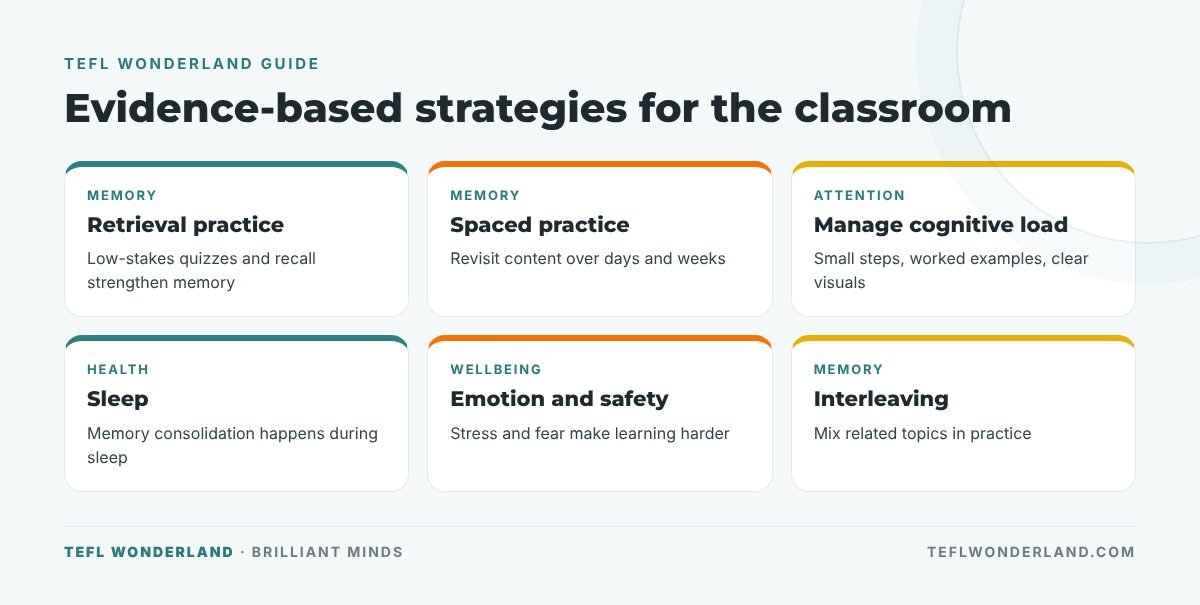
The neuroscience of learning and cognitive science point to the same practical strategies. A major review of ten learning techniques rated practice testing and distributed (spaced) practice as the most effective, while highlighting and rereading were rated much lower (Dunlosky et al., 2013).
Neuromyths: what the evidence does not support
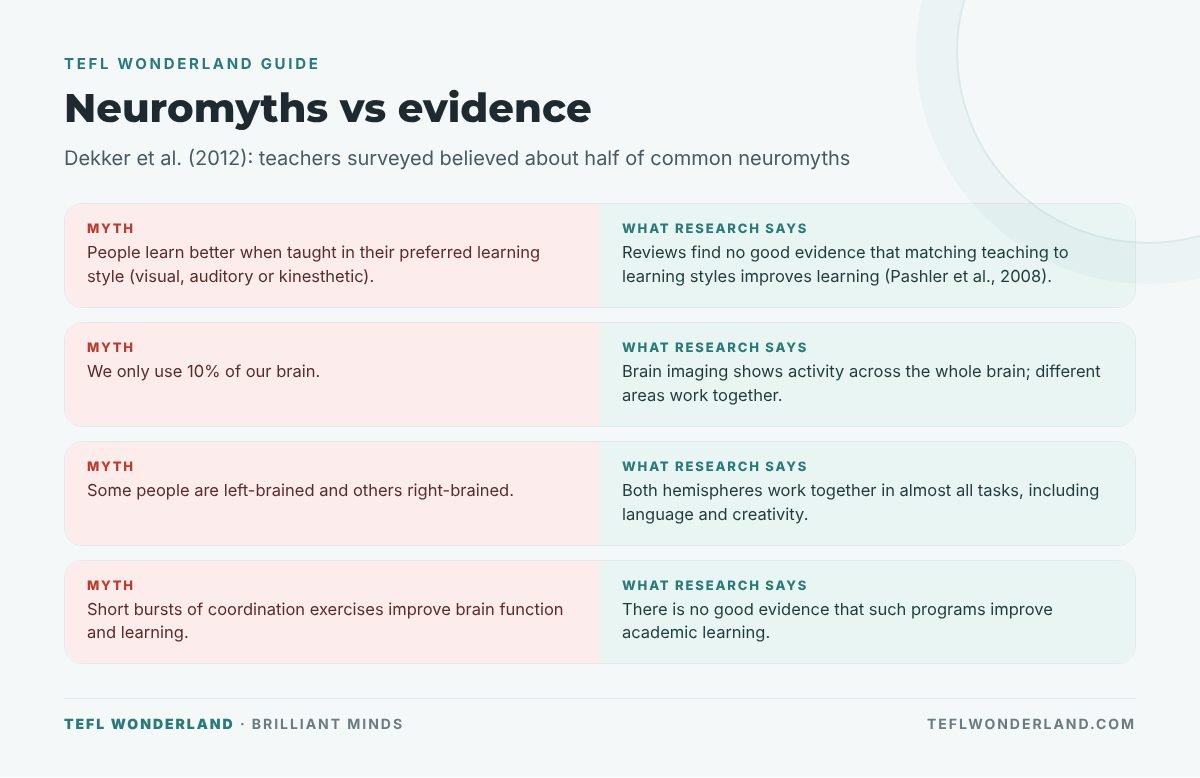
In a survey of 242 teachers in the UK and the Netherlands, teachers believed on average about half of the neuromyths presented, and more than nine in ten agreed that people learn better in their preferred learning style (Dekker et al., 2012). Surprisingly, teachers with more general knowledge about the brain were more likely to believe some myths, so it’s worth checking claims carefully.
The best-known myth is learning styles: the idea that each person learns best through one channel (visual, auditory or kinesthetic) and that teaching should match it. A careful review found no good evidence that matching instruction to learning styles improves learning (Pashler et al., 2008). Using pictures, sound and movement is great, but because they help everyone understand, not because of individual “styles”.
How to use the neuroscience of learning in class
- Start lessons with a short retrieval quiz on earlier topics.
- Plan spaced reviews into your scheme of work.
- Break new material into small steps with examples.
- Keep slides simple; explain visuals with your voice.
- Mix related topics in practice (interleaving).
- Build a safe classroom culture where mistakes are part of learning.
- Be skeptical of products that claim to be “brain-based” without evidence.
FAQs
Is “brain-based learning” supported by research?
Some practices labeled brain-based, such as retrieval and spacing, are well supported. Others, such as learning styles or “brain gym” exercises, are not. Look for evidence, not labels.
Do teachers need to study neuroscience?
Not in depth. Understanding a few well-supported principles of memory and attention, and recognizing common myths, is enough to improve teaching.
Is the neuroscience of learning different for language learning?
The same principles apply: retrieval, spacing, manageable load and a low-stress environment all help vocabulary and grammar stick.
Keep learning
Our teacher development courses include practical courses on assessment, Universal Design for Learning, lesson planning and teaching the four skills, all built on these principles. Our TESOL courses use checkpoint tests and spaced reviews in every zone.
References and further reading
- Dekker, S., Lee, N. C., Howard-Jones, P., & Jolles, J. (2012). Neuromyths in education: Prevalence and predictors of misconceptions among teachers. Frontiers in Psychology, 3, 429. doi.org/10.3389/fpsyg.2012.00429
- Howard-Jones, P. A. (2014). Neuroscience and education: Myths and messages. Nature Reviews Neuroscience, 15, 817–824. doi.org/10.1038/nrn3817
- Pashler, H., McDaniel, M., Rohrer, D., & Bjork, R. (2008). Learning styles: Concepts and evidence. Psychological Science in the Public Interest, 9(3), 105–119. doi.org/10.1111/j.1539-6053.2009.01038.x
- Dunlosky, J., Rawson, K. A., Marsh, E. J., Nathan, M. J., & Willingham, D. T. (2013). Improving students’ learning with effective learning techniques. Psychological Science in the Public Interest, 14(1), 4–58. doi.org/10.1177/1529100612453266
- Roediger, H. L., & Karpicke, J. D. (2006). Test-enhanced learning. Psychological Science, 17(3), 249–255. doi.org/10.1111/j.1467-9280.2006.01693.x
- Cepeda, N. J., et al. (2006). Distributed practice in verbal recall tasks. Psychological Bulletin, 132(3), 354–380. doi.org/10.1037/0033-2909.132.3.354
- Sweller, J. (1988). Cognitive load during problem solving: Effects on learning. Cognitive Science, 12(2), 257–285. doi.org/10.1207/s15516709cog1202_4
- Diekelmann, S., & Born, J. (2010). The memory function of sleep. Nature Reviews Neuroscience, 11, 114–126. doi.org/10.1038/nrn2762
- OECD (2007). Understanding the Brain: The Birth of a Learning Science. OECD Publishing.