
The words are often used together, but they mean different things. Assessment is about collecting evidence of what learners know and can do. Evaluation is about judging the value or effectiveness of something, such as a lesson, a course or a training program. Good assessment and evaluation help learners improve, help teachers adjust their teaching and help schools decide what works. This guide explains the key ideas and gives you practical tools.
Assessment vs evaluation
In assessment and evaluation, the difference is the focus:
- Assessment focuses on the learner: Can Ana describe a past event in English? Has Omar mastered fractions?
- Evaluation focuses on the program: Did this course help teachers manage classes better? Is our new reading program working?
Both rely on good evidence, clear criteria and honest reflection, which is why assessment and evaluation are usually planned together.
Formative and summative assessment
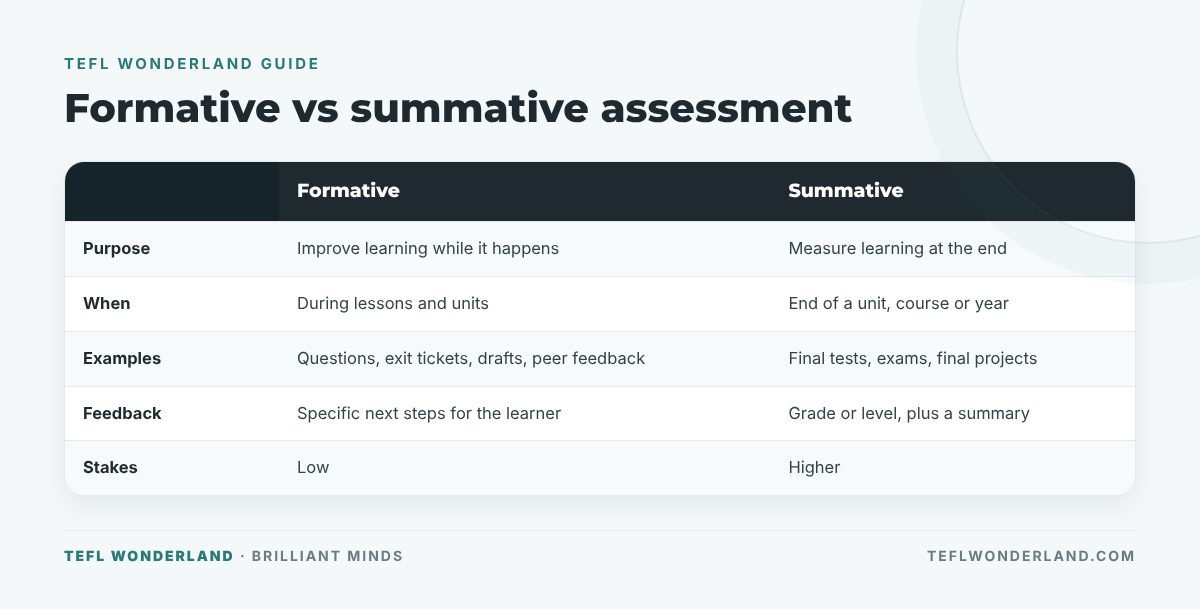
Formative assessment happens during learning, to guide the next step. Summative assessment happens at the end, to measure what was learned. In a famous review, Paul Black and Dylan Wiliam (1998) found that strengthening formative assessment, especially through feedback and student involvement, produced significant learning gains. Dylan Wiliam later described five key strategies (Wiliam, 2011):
- clarifying and sharing learning intentions and success criteria;
- engineering effective classroom discussions and tasks that show evidence of learning;
- providing feedback that moves learners forward;
- activating students as learning resources for one another;
- activating students as owners of their own learning.
Practical formative assessment techniques
- Exit tickets: one or two questions at the end of the lesson.
- Mini-whiteboards: everyone answers at the same time, so you see the whole class.
- Hinge questions: a multiple-choice question that shows whether the class is ready to move on.
- Traffic lights: learners show green, amber or red for how confident they feel.
- Peer and self-assessment with simple checklists.
Feedback that works
John Hattie and Helen Timperley’s review describes feedback as answering three questions: Where am I going? How am I going? Where to next? They also distinguish four levels of feedback: about the task, the process, self-regulation and the self (praise), and found that praise about the person (“You’re so clever”) is the least useful for learning (Hattie & Timperley, 2007). In practice:
- be specific (“Your paragraph has a clear topic sentence; now add an example”);
- focus on one or two next steps, not every error;
- give learners time to act on the feedback.
Rubrics and success criteria
A rubric describes levels of performance for each criterion, for example organization, vocabulary, accuracy and fluency for a speaking task. Share rubrics before the task, use them for self- and peer-assessment, and keep the language simple enough for learners to understand.
Language assessment and the CEFR
For language teachers, the Common European Framework of Reference (CEFR) provides “can do” descriptors from A1 to C2. They help you write clear objectives, design tasks at the right level and report progress in terms of what learners can actually do. Good language assessment includes all four skills, uses realistic tasks and checks both accuracy and communication.
Evaluating courses and training
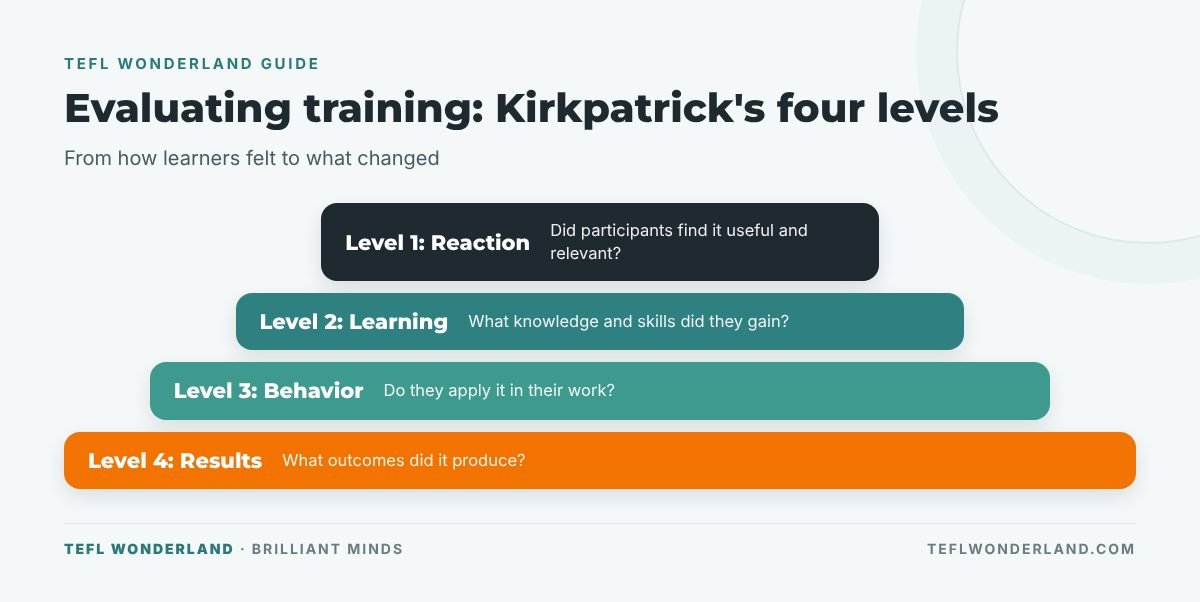
The Kirkpatrick Model evaluates training at four levels: reaction, learning, behavior and results (Kirkpatrick Partners). Most courses only measure the first level with a satisfaction survey. Adding a short pre- and post-test (learning), a follow-up observation or survey a few weeks later (behavior) and a look at real outcomes (results) gives a much fuller picture of whether a course works.
Fair and reliable assessment and evaluation
- Validity: does the task measure what you want to measure?
- Reliability: would different markers, or the same marker on another day, give the same result?
- Fairness: do all learners have a fair chance, including those with disabilities or different backgrounds?
- Practicality: is it realistic in the time available?
Universal Design for Learning (UDL) can help by offering more than one way for learners to show what they know.
Develop your assessment and evaluation skills
Assessment and evaluation are skills that improve with practice and feedback. Our course New Trends in Assessment and Tracking Student Progress (in Arabic) covers modern assessment tools, rubrics and tracking progress. It is part of our teacher development courses. Our TESOL courses also include assessment in language teaching, with assignments marked by experts.
FAQs
What is the difference between assessment and evaluation?
Assessment collects evidence about learners’ knowledge and skills; evaluation judges the effectiveness or value of a lesson, course or program.
How often should I use formative assessment?
Every lesson. Short, low-stakes checks, such as questions, exit tickets or mini-whiteboards, take only a few minutes and guide your next step.
Are grades necessary?
Summative grades are often required, but learning improves most through feedback. Many teachers give feedback first and grades later, so learners focus on improving.
References and further reading
- Black, P., & Wiliam, D. (1998). Assessment and classroom learning. Assessment in Education: Principles, Policy & Practice, 5(1), 7–74. doi.org/10.1080/0969595980050102
- Wiliam, D. (2011). Embedded Formative Assessment. Solution Tree Press.
- Hattie, J., & Timperley, H. (2007). The power of feedback. Review of Educational Research, 77(1), 81–112. doi.org/10.3102/003465430298487
- Council of Europe. Common European Framework of Reference for Languages (CEFR). coe.int
- Kirkpatrick Partners. The Kirkpatrick Model. kirkpatrickpartners.com