
Artificial intelligence has arrived in every staffroom. Used well, AI in teaching English saves hours of preparation and gives each learner more practice and feedback. Used badly, it produces generic lessons and copied homework. This guide gives you ten practical uses, sample prompts you can copy, and simple rules for using AI safely and fairly.
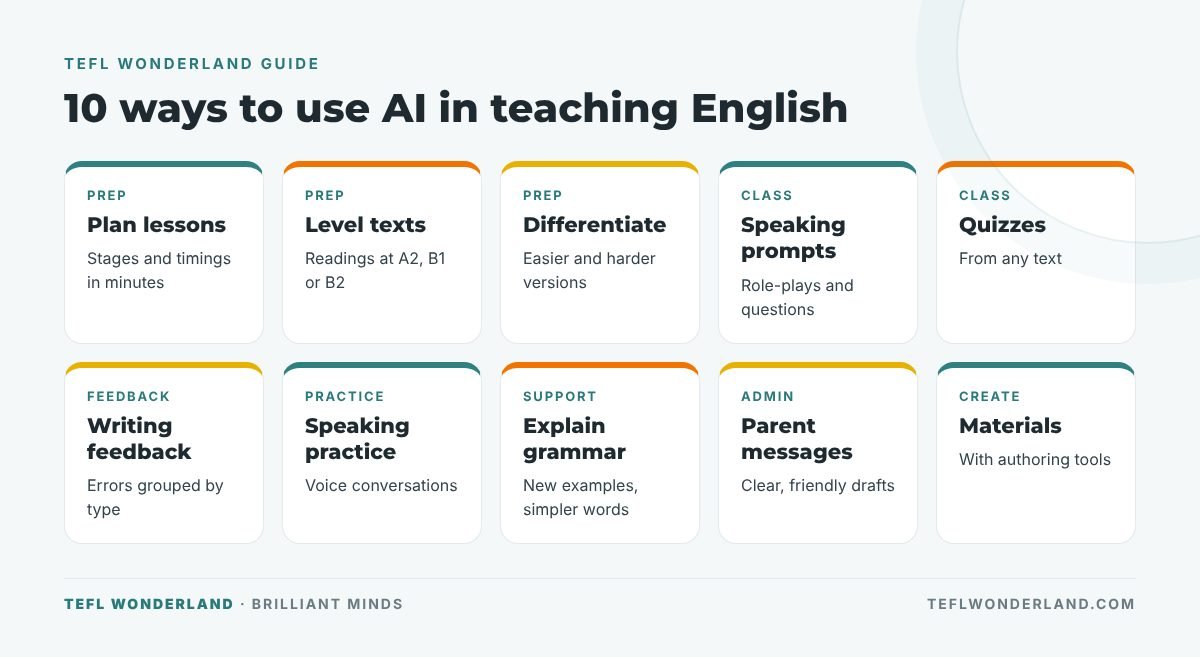
1. Plan a lesson in minutes
The quickest win with AI in teaching English is planning. Give an AI assistant your learners’ age, level, topic and lesson length, and ask for a lesson plan with stages and timings. Then edit it: you know your class, the AI doesn’t.
Sample prompt: “Write a 60-minute lesson plan for 12 adult B1 learners on talking about past travel. Include a warmer, a short reading, the past simple vs present perfect, controlled practice, a speaking task and a 5-minute review. Add timings and interaction patterns.”
Treat the result as a first draft. Check that the aim is clear and that students spend most of the lesson using English, not listening to you.
2. Create texts at the right level
Ask for a short reading text about a topic your students love, written at A2 or B1 level of the Common European Framework of Reference (CEFR), with five target words in bold. Then ask for the same text at B2 for stronger learners. Always read it yourself: AI texts can contain unnatural phrases or wrong facts.
3. Differentiate one activity for three levels
Paste an activity and ask for an easier version with more support (word banks, sentence starters) and a harder version with an extra challenge. Mixed-level classes are the norm, and this is one of the most useful forms of AI in teaching English.
4. Generate speaking prompts and role-plays
Ask for ten discussion questions, a role-play with two roles and a problem to solve, or “would you rather” questions for a warmer. You can ask for prompts linked to your students’ jobs, interests or local context.
5. Make quizzes and games
AI can turn any text into multiple-choice questions, gap-fills or true/false sentences, ready to paste into a quiz platform. Combine this with gamification, such as points, teams and levels, for extra motivation.
6. Give faster writing feedback
Ask an AI tool to highlight errors in a student text and group them (verb tenses, articles, word order) without rewriting it. You check, choose the two or three most important points and add your own comment. Research on feedback shows it works best when it is specific and tells learners what to do next (Hattie & Timperley, 2007), so keep the focus on next steps.
7. Let learners practice speaking
Voice-based AI tools let students practice conversations, interviews or exam speaking tasks outside class. Set a clear task (“order food in a café, then complain politely about a wrong order”) and ask them to bring one new phrase back to the lesson.
8. Explain grammar in different ways
If a student still doesn’t understand a grammar point, ask the AI for a simpler explanation, a timeline, a comparison with their first language or ten fresh example sentences. Check the explanation before you share it.
9. Write messages to parents and reports
AI can help you draft clear, friendly messages and report comments. Always personalize them, and never paste in private student information.
10. Build your own teaching materials
Combine AI with authoring tools to create interactive worksheets, flashcards, branching scenarios and short videos. This is where AI in teaching English moves from saving time to creating richer lessons.
Simple rules for AI in teaching English
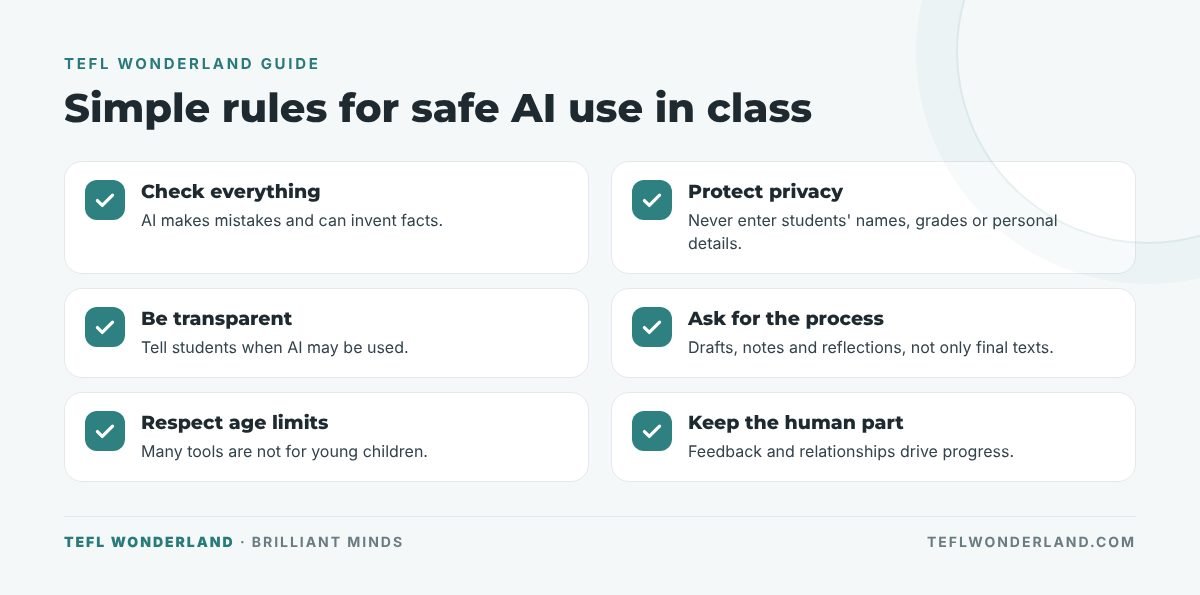
UNESCO’s guidance on generative AI in education recommends a human-centered approach: protecting data privacy, setting age-appropriate rules and building teachers’ and learners’ AI skills (UNESCO, 2023). In the classroom, that means:
- Check everything. AI tools make mistakes and can invent facts or sources.
- Protect privacy. Don’t enter names, grades or personal details of students.
- Be clear with students. Explain when AI may be used for homework and when it may not. Ask them to show their process: notes, drafts and reflections.
- Design tasks that need thinking. Personal experiences, local topics, in-class writing and oral presentations are harder to outsource.
- Keep the human part. Feedback, encouragement and relationships are what make learners progress.
Should students use AI for homework?
This is one of the hardest questions about AI in teaching English.
It depends on the goal of the task. If the aim is fluency in writing, students should write themselves first. If the aim is research or idea generation, AI can be a helpful partner. A simple traffic-light system works well: green tasks (AI allowed), amber tasks (AI allowed for ideas only, with a note explaining how) and red tasks (no AI).
Learn AI in teaching English with confidence
Our live course, Integrating AI and Authoring Tools for Enhanced Teaching, Assessment, and Administrative Efficiency, shows teachers and school leaders how to plan, assess and create materials with AI step by step. You can also start with Using Technology in Teaching. Both are part of our teacher development courses.
FAQs
Will AI replace English teachers?
No. AI can produce texts and exercises, but it cannot build relationships, read the room or motivate a nervous learner. Teachers who use AI well will simply have more time for those things.
What is the easiest way to start using AI in teaching English?
Start with one task you do every week, such as making a quiz from a reading text. Once AI in teaching English saves you time there, add another task.
Is it safe for young learners to use AI tools?
Many AI tools have age limits. For young learners, the teacher should use AI to prepare materials, rather than students using the tools directly.
References and further reading
- UNESCO (2023). Guidance for generative AI in education and research. unesco.org
- UNESCO (2024). AI competency framework for teachers. Paris: UNESCO.
- Council of Europe. Common European Framework of Reference for Languages (CEFR). coe.int
- Hattie, J., & Timperley, H. (2007). The power of feedback. Review of Educational Research, 77(1), 81–112. doi.org/10.3102/003465430298487
- ISTE. ISTE Standards for Educators. iste.org