
Why do learners who “hate homework” spend hours trying to reach the next level of a game? Games give clear goals, quick feedback, a feeling of progress and a reason to keep going. Gamification in the classroom borrows those ideas and uses them for learning. At TEFL Wonderland, all our courses are gamified, and we have seen how it changes motivation. This guide explains what gamification is, what research says, nine ideas you can use tomorrow and the mistakes to avoid.
What gamification in the classroom is (and isn’t)
Researchers define gamification as “the use of game design elements in non-game contexts” (Deterding et al., 2011). In a classroom, that means adding elements such as points, levels, badges, missions, teams and a story to activities that are not games.
It is different from game-based learning, where students play an actual game (a vocabulary board game, a quiz show). A vocabulary game is game-based learning; a term-long “expedition” where students earn points for every new word they use, unlock levels and complete missions is gamification. Both are useful, and they work well together.
Why gamification works
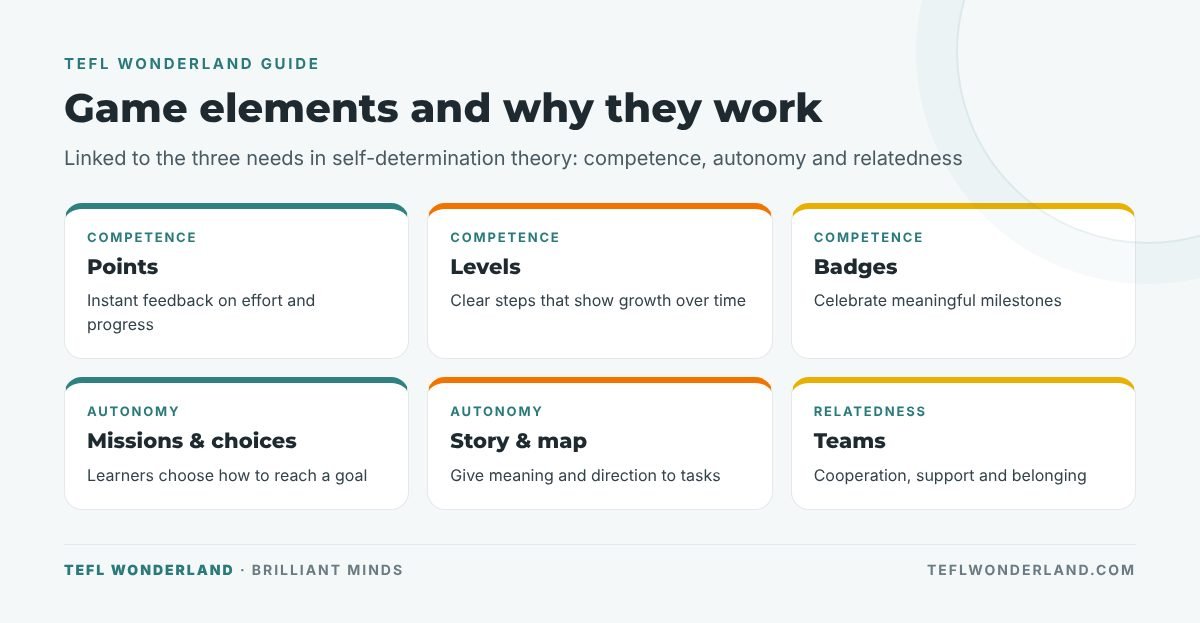
Self-determination theory, one of the best-known theories of motivation, says people are more motivated when three needs are met: competence (I can do this and I am improving), autonomy (I have some choice) and relatedness (I belong to a group) (Ryan & Deci, 2000). Good gamification supports all three: points and levels show competence, missions and choices give autonomy, and team challenges build relatedness.
What the research says
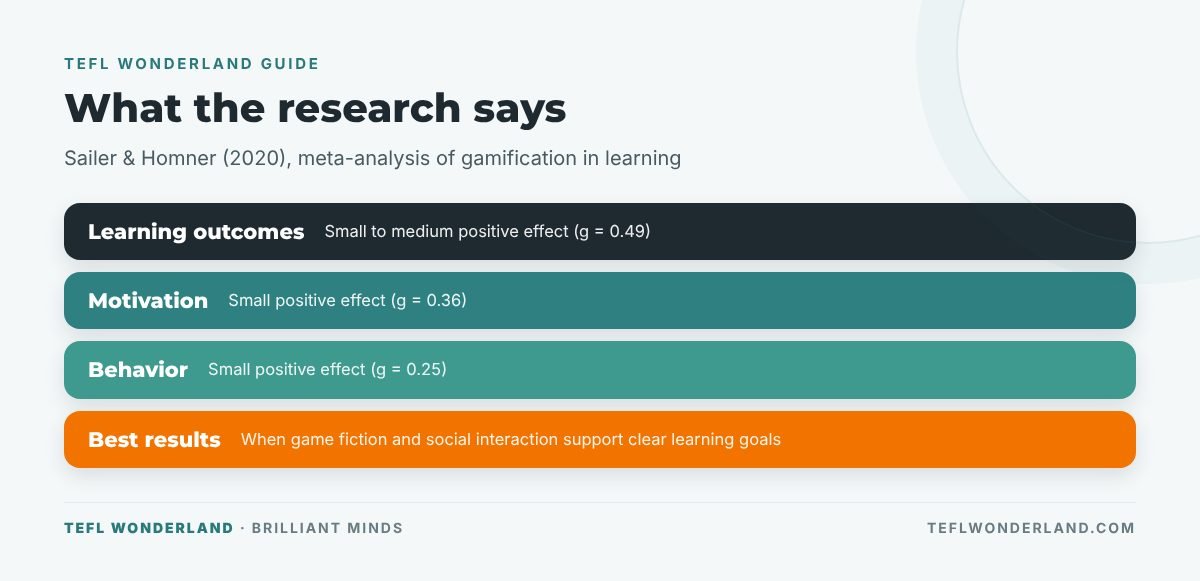
Gamification is not magic, but the evidence is encouraging. A large meta-analysis of gamification in education found small to medium positive effects on cognitive learning outcomes, and small positive effects on motivation and behavior (Sailer & Homner, 2020). An earlier review of empirical studies concluded that gamification “works”, but that its effects depend strongly on the context and on the users (Hamari, Koivisto & Sarsa, 2014).
The practical message for teachers: gamification helps most when it supports clear learning goals, gives frequent feedback and includes social interaction. Points on their own, without meaningful tasks, have much smaller effects.
9 ideas for gamification in the classroom
1. Turn the course into a map
Divide your syllabus into “worlds” or “zones”, each with a few “territories” (units). Show the map on the wall or online and let students see where they are. Progress becomes visible, and so does the next goal.
2. Award points for the right things
Give points for effort and learning behaviors (using new words, helping a partner, correcting your own mistake), not only for correct answers. This keeps weaker students in the game.
3. Use levels instead of grades
“Level 4 Explorer” feels more motivating than “62%”. Levels tell learners that they can always move up, and they match the idea of language levels (A1 to C2).
4. Create missions
A mission is a small project with a clear goal: “Interview three people about their weekend and report back”, or “Write a review of your favorite app”. Missions connect language to real use and give students choices.
5. Add badges for milestones
Badges celebrate milestones: first presentation, ten books read, a perfect week of homework. Keep them meaningful; if everyone gets every badge, they lose value.
6. Play in teams
Team challenges build cooperation and reduce the pressure on individual students. Mix levels in each team so stronger learners support others.
7. Use leaderboards carefully
Leaderboards motivate some learners and discourage others. Try team leaderboards, “most improved” boards or seasonal boards that reset, so everyone has a fresh chance.
8. Give instant feedback
Quick quizzes on phones or mini-whiteboards show students immediately how they did. Fast feedback is one of the main reasons games are so engaging.
9. Add a story
A simple story, such as explorers crossing a new land, gives meaning to tasks. Students remember language better when it is part of a narrative, and a story is the glue that holds gamification in the classroom together. Competitions like our WEB Olympiad work the same way: learners practice with a clear, exciting goal.
Mistakes to avoid with gamification in the classroom
- Rewards without learning. Points must be linked to language goals, or the game becomes the goal.
- Too much competition. Balance individual and team challenges, and celebrate improvement, not only winners.
- Too complicated. If the rules need ten minutes to explain, simplify them.
- Forgetting reflection. Ask “What did you learn while earning those points?”
- Never changing anything. Novelty fades; add new missions or a new “season” every few weeks.
How to start gamification in the classroom in one week
- Choose one class and one goal (for example, more speaking in English).
- Draw a simple map with five levels.
- Decide three ways to earn points, and one team challenge.
- Introduce it as a story in the first lesson.
- After two weeks, ask students what they like and change one thing.
How we use gamification in the classroom and online
We use gamification in the classroom and in every online course. Our TESOL courses are built as an adventure: eight zones, territories with checkpoint tests, missions, points and badges. Our English courses for children and teens use the same approach, so learners always know their next step.
FAQs
Does gamification in the classroom work for adults?
Yes, if it respects adult goals. Adults respond well to clear progress, levels and team challenges, especially when the tasks are practical and relevant to their work.
Do I need technology for gamification in the classroom?
No. A paper map, stickers and a points chart work well. Technology just makes tracking easier.
How long before I see results?
Many teachers notice more participation in the first weeks. The real benefit, steady practice and better results, comes when the system runs all term.
References and further reading
- Deterding, S., Dixon, D., Khaled, R., & Nacke, L. (2011). From game design elements to gamefulness: Defining “gamification”. Proceedings of the 15th International Academic MindTrek Conference, 9–15. doi.org/10.1145/2181037.2181040
- Sailer, M., & Homner, L. (2020). The gamification of learning: A meta-analysis. Educational Psychology Review, 32, 77–112. doi.org/10.1007/s10648-019-09498-w
- Hamari, J., Koivisto, J., & Sarsa, H. (2014). Does gamification work? A literature review of empirical studies on gamification. 47th Hawaii International Conference on System Sciences, 3025–3034. doi.org/10.1109/HICSS.2014.377
- Ryan, R. M., & Deci, E. L. (2000). Self-determination theory and the facilitation of intrinsic motivation, social development, and well-being. American Psychologist, 55(1), 68–78. doi.org/10.1037/0003-066X.55.1.68