
If you are thinking about teaching English, you have probably met a wall of acronyms: TEFL, TESOL, TESL, CELTA, CertTESOL. Course websites use them in different ways, and it is easy to feel lost before you even start. In this guide we compare TESOL vs TEFL (and where CELTA and Trinity CertTESOL fit in), explain what “Level 3” and “Level 5” really mean, and give you a simple way to choose a qualification that employers will recognize.
What TEFL means
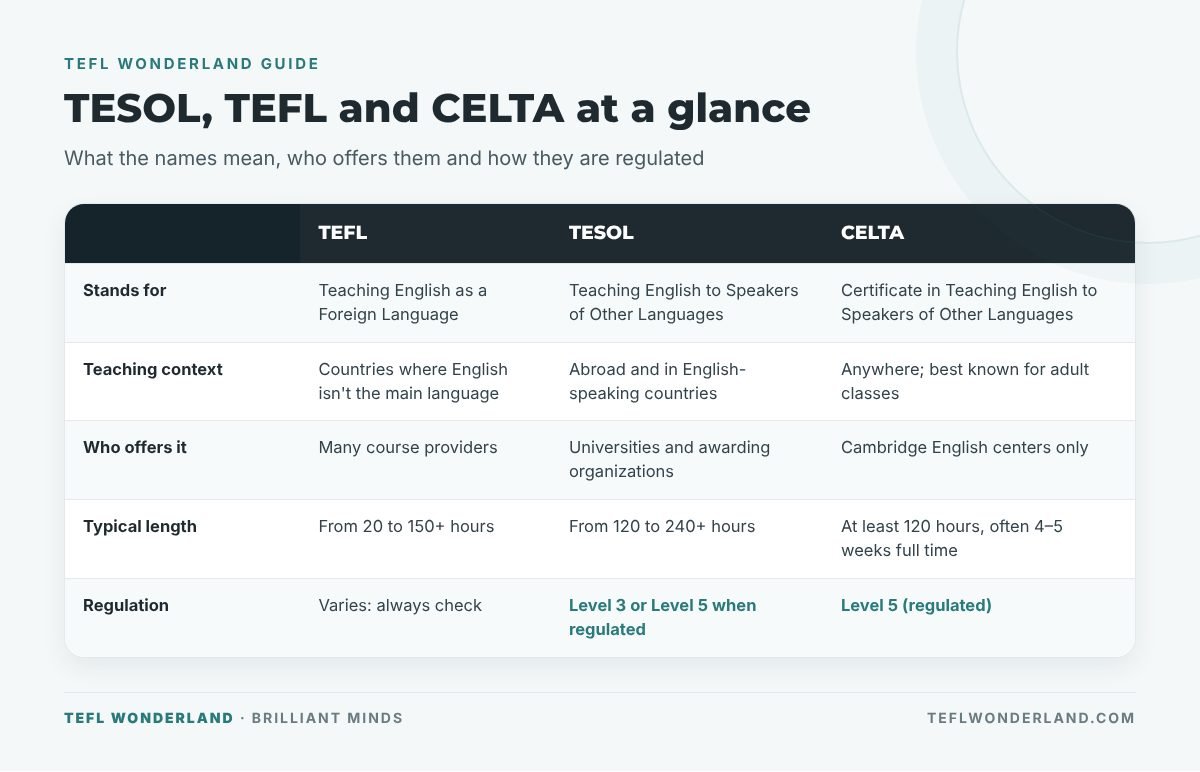
TEFL stands for Teaching English as a Foreign Language. It describes teaching English in a country where English is not the main language of daily life: for example, children in Vietnam, adults in Brazil or engineers in Saudi Arabia. Learners mostly meet English in the classroom, so TEFL teachers focus on plenty of speaking practice, clear models of language and real-life contexts.
The word TEFL is used freely. There is no single organization that controls it, so a “TEFL certificate” can mean a 20-hour online taster or a 150-hour course with observed teaching. That is why the label alone tells an employer very little.
What TESOL means
TESOL stands for Teaching English to Speakers of Other Languages. It is the umbrella term. It covers TEFL (teaching abroad) and TESL, Teaching English as a Second Language: for example, teaching newcomers in Canada, the United States or the United Kingdom, who need English for work, school and everyday life.
Because it covers both settings, universities, professional bodies and awarding organizations tend to prefer TESOL. The global professional association for English language teachers, for instance, is called TESOL International Association.
TESOL vs TEFL: is there a real difference?
For most jobs, no. When people compare TESOL vs TEFL they often expect one to be “better”, but employers rarely care about the acronym. They look at four things:
- Hours: many schools ask for at least 120 hours of training.
- Level and regulation: is the qualification regulated by a recognized government body, and at what level?
- Teaching practice: have you taught real learners and received feedback from a qualified trainer?
- Assessment: were your assignments marked by tutors, or did you only click through quizzes?
A weekend “TEFL” certificate and a 140-hour regulated TESOL certificate are very different things, even though both use a familiar acronym. So the useful question is not simply TESOL vs TEFL, but how good is this specific course, and can an employer check it?
Where CELTA and Trinity CertTESOL fit in
CELTA is a specific qualification from Cambridge English: the Certificate in Teaching English to Speakers of Other Languages. All CELTA courses include at least 120 hours and observed teaching practice with real learners, and full-time courses usually take four to five weeks (Cambridge English). It is regulated in the UK at Level 5 and is especially well known in adult language schools.
Trinity CertTESOL from Trinity College London is a close equivalent. It is also regulated at Level 5, with 130 guided learning hours (200 hours of total qualification time) and at least six hours of teaching practice with real learners (Trinity College London).
Both are excellent, but they are intensive and usually require attendance at a training center or fixed online sessions, which can be hard to combine with a full-time job.
Levels: what Level 3 and Level 5 mean
In England, Wales and Northern Ireland, regulated qualifications have a level on the Regulated Qualifications Framework (RQF). The UK government lists A levels as Level 3 qualifications, and foundation degrees and Higher National Diplomas (HNDs) as Level 5 (GOV.UK). In practice:
- Level 3 is a solid professional start for new teachers. It covers planning, teaching the four skills, grammar, vocabulary and classroom management.
- Level 5 goes deeper into methodology, assessment, materials design and teaching specific groups. It is at the same level as CELTA and Trinity CertTESOL.
Our TESOL courses follow this structure. The Certificate in TESOL is Level 3 (140 hours) and the Diploma in TESOL is Level 5 (220 hours). Both are awarded by Gatehouse Awards and regulated by Ofqual. The Premier versions add 20 hours of Guided Teaching Practice with real students.
Online, in-person or blended?
In the TESOL vs TEFL vs CELTA choice, format is often the deciding factor.
All three formats can lead to a respected qualification:
- Online, self-paced courses fit around work and family. You need discipline, but you can study from anywhere.
- Intensive in-person courses are fast and immersive, but you need several free weeks and the course fee often comes with travel and accommodation costs.
- Blended options combine online theory with live teaching practice, which gives you flexibility and real classroom experience.
TESOL vs TEFL: how to choose (a quick checklist)
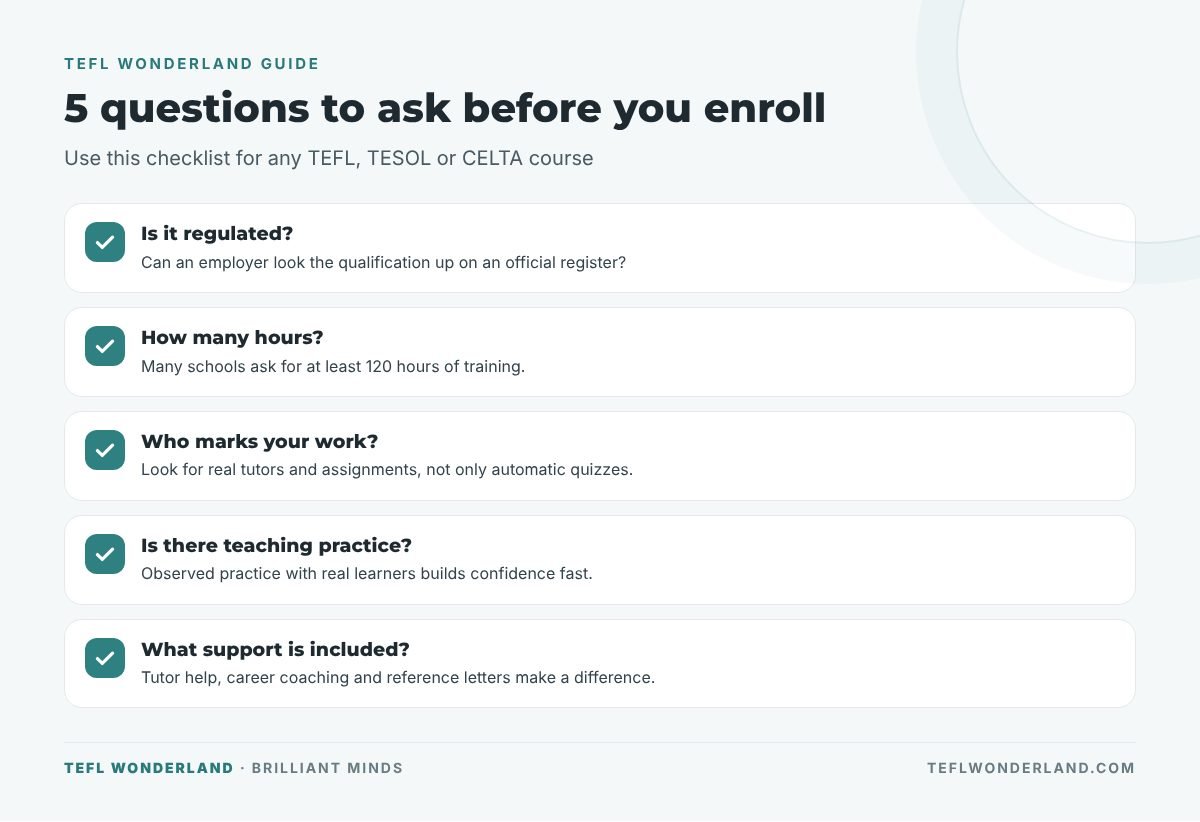
- Where do you want to teach? Read ten job ads in your target country and note what they ask for. Many list “120+ hours TEFL/TESOL” as the minimum; some ask for CELTA or an equivalent Level 5.
- Who do you want to teach? Young learners, teenagers, adults, business professionals or exam classes each need different skills.
- How much time do you have? A self-paced online course fits around work; an intensive course needs several free weeks.
- Do you want teaching practice? If you have never taught before, observed practice with feedback builds confidence fast.
- Is it regulated? Look the qualification up on the Ofqual Register of Regulated Qualifications or your country’s equivalent.
Common myths about TESOL vs TEFL
- “TEFL is only for teaching abroad.” Many TEFL holders teach online or in their home countries too.
- “TESOL is only for teaching in English-speaking countries.” TESOL covers both settings, so a TESOL certificate works abroad as well.
- “Only native speakers can get a TESOL or TEFL certificate.” Advanced English (around C1) is what matters.
- “CELTA is the only qualification schools accept.” Many schools accept any regulated Level 3 or Level 5 TESOL, or 120+ hours of good training.
The bottom line on TESOL vs TEFL
In the TESOL vs TEFL debate, the label matters far less than the quality behind it. Choose a course with enough hours, real assessment, tutor support and, ideally, teaching practice. If it is also regulated at Level 3 or Level 5, schools around the world can check exactly what you studied.
FAQs
Is TESOL or TEFL better for teaching abroad?
Neither is better by name. Schools abroad look at hours (often 120 or more), regulation and teaching practice. A regulated TESOL certificate meets the same requirements as a good TEFL certificate.
Is a Level 5 TESOL the same as CELTA?
They are at the same level on the UK framework, but they are different qualifications from different awarding organizations. Both show employers that you have studied teaching methodology in depth.
Do I need a degree to get a TESOL certificate?
No. You need advanced English (around CEFR C1) to join our courses. Some countries need a degree for a work visa, but that is a visa rule, not a course rule.
References and further reading
- Cambridge English. CELTA (Certificate in Teaching English to Speakers of Other Languages). cambridgeenglish.org
- Trinity College London. Certificate in Teaching English to Speakers of Other Languages (CertTESOL). trinitycollege.com
- GOV.UK. What qualification levels mean: list of qualification levels. gov.uk
- Ofqual. Register of Regulated Qualifications. register.ofqual.gov.uk
- TESOL International Association. tesol.org
Ready to start? Compare the Level 3 and Level 5 options on our TESOL courses page, or book a free call and we will help you choose.