

Most parents want the same thing as teachers: for their child to be happy, safe and learning. Yet conversations with parents can be some of the most stressful parts of the job, especially when something has gone wrong. Good parent-teacher communication turns parents into partners. This guide covers how to build trust from the first week, keep parents informed, run effective meetings and handle difficult conversations calmly.
Why parent-teacher communication matters
Good parent-teacher communication is not a nice extra; it is part of teaching. Research has shown for decades that family engagement is linked to better attendance, behavior and achievement. A widely cited review by Henderson and Mapp (2002) concluded that when schools and families work together to support learning, children tend to do better in school and stay in school longer. The Education Endowment Foundation’s guidance on working with parents makes a related point: the most useful communication is about learning, not only about behavior or events, and it offers parents practical ways to help at home (EEF).
Joyce Epstein’s framework of six types of involvement (parenting, communicating, volunteering, learning at home, decision-making and collaborating with the community) is a useful way for schools to check whether they are offering parents more than just reports and complaints (Epstein et al., 2018).
Build trust before you need it
Parent-teacher communication works best when it starts early. The best time to build a relationship with parents is before any problem appears.
- Send a short welcome message in the first week: who you are, what students will learn this term and how to contact you.
- Share one positive news item about each child in the first month. A two-line message (“Sara helped a new classmate today and used three new words in her presentation”) builds enormous goodwill.
- Explain how you communicate: which channel, when you reply (for example, within two working days) and when it’s better to request a meeting.
- Use simple, clear language. Many parents of English learners are themselves learning English; avoid jargon and acronyms.
Keep parents informed about learning
Regular, predictable updates prevent surprises. Useful options include:
- a short weekly or monthly newsletter with what students learned and one thing to try at home;
- photos or examples of work (with your school’s privacy rules in mind);
- clear progress reports that show what the child can now do, not only grades.
The EEF recommends tailoring communication to encourage positive dialogue about learning, for example by suggesting one question parents can ask at dinner: “What new English word did you use today?”
Running a good parent meeting
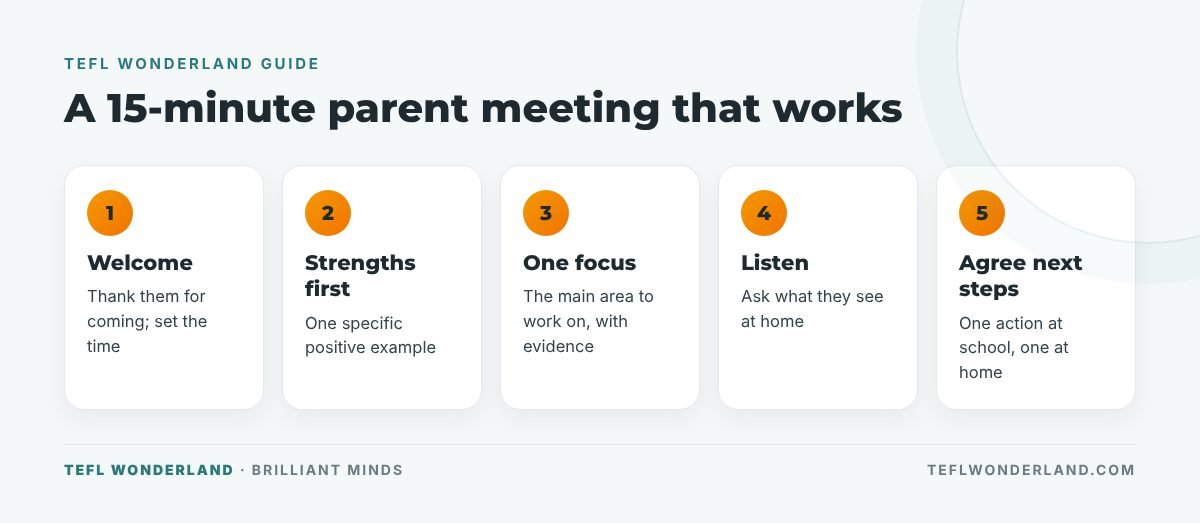
Prepare a few notes and examples of the child’s work. Start with genuine strengths, focus on one main area to work on (with evidence), and ask parents what they see at home: they know their child in ways you don’t. End by agreeing one action at school and one at home, and a date to check in. Then send a short written summary so everyone remembers the same plan.
Difficult conversations
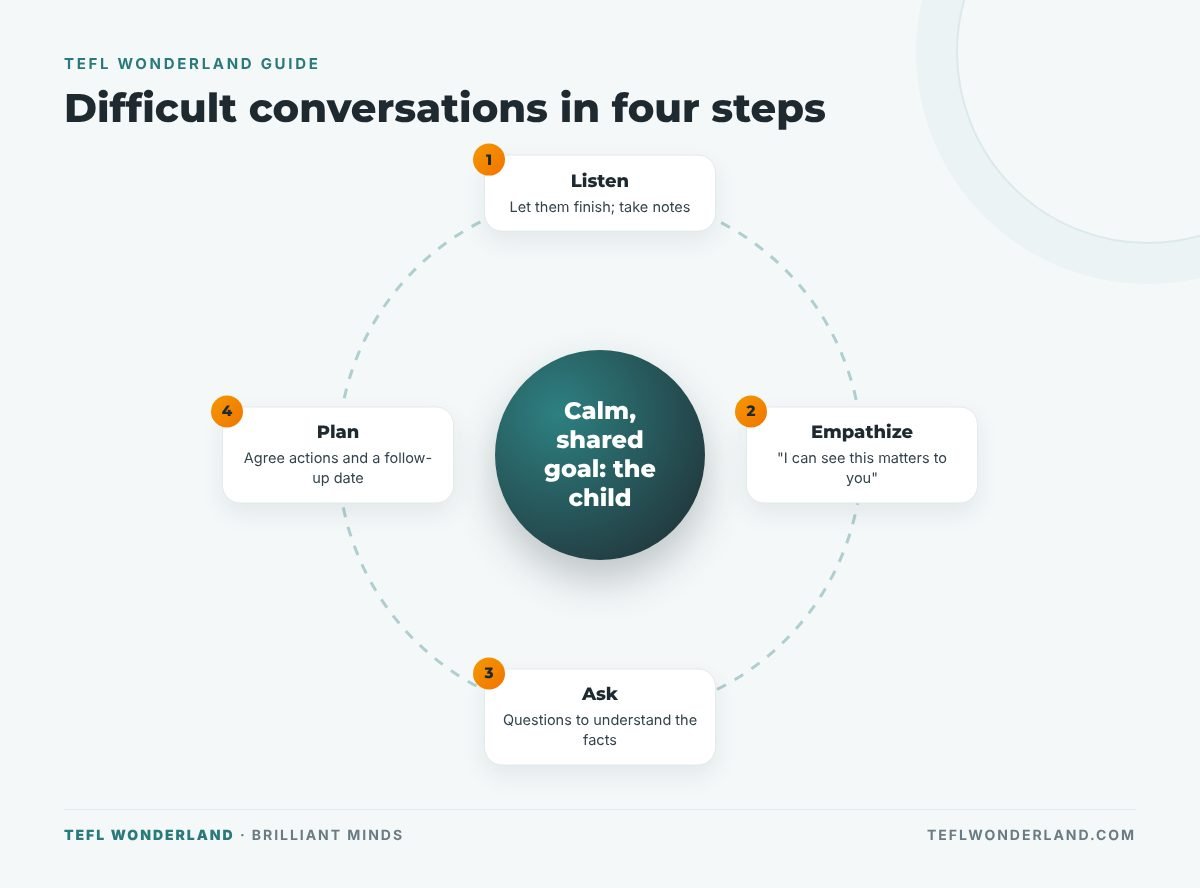
Difficult conversations are where parent-teacher communication skills matter most. Sooner or later, every teacher meets an upset or angry parent. A simple structure helps you stay calm:
- Listen without interrupting, and take notes. Many parents calm down once they feel heard.
- Empathize with the feeling, even if you disagree with the facts: “I can see this is really worrying for you.”
- Ask questions to understand exactly what happened and what they would like to see.
- Plan together: agree specific actions, who does what, and when you will follow up.
A few more rules make a big difference:
- Don’t argue by email or message. Offer a call or meeting instead: “Thank you for your message. I’d like to understand properly; could we talk on Tuesday at 4 pm?”
- Stick to facts and the child’s learning. Avoid comparing the child with other students.
- Know when to involve a leader. If a parent is abusive, or the issue involves safeguarding, follow your school’s policy and involve your coordinator or principal.
Handling complaints
Complaints are a chance to improve. Acknowledge the complaint quickly, explain the process and timeline, investigate fairly and reply in writing. Keep a record of all communication. Schools that handle complaints transparently usually build more trust, not less.
Parent-teacher communication across cultures
Expectations about school, homework and the teacher’s role vary across cultures. Some parents expect frequent contact; others see the teacher as the expert and rarely ask questions. Ask parents how they prefer to communicate (for parent-teacher communication, the channel matters as much as the message), offer translated messages where possible, and invite them to share what education was like in their country. In international schools and language centers, good parent-teacher communication is as much about cultural curiosity as about language.
Templates you can adapt
Positive update: “Hello Mrs. Khan, I wanted to share some good news: today Omar led his group’s presentation and used the new vocabulary very confidently. Thank you for your support at home!”
Meeting request: “Dear Mr. Silva, I’d like to talk with you about how we can help Ana with her reading this term. Would Thursday at 3:30 pm or Friday at 9 am suit you? The meeting will take about 15 minutes.”
Develop your skills
Our course Mastering Parent Handling Skills for Teachers and Administrators covers communication, meetings, difficult conversations and complaints in depth, with real scenarios. It is included free with our Level 3 and Level 5 TESOL courses, and also available on its own in our teacher development courses, alongside Conflict Resolution in Educational Institutions.
FAQs
How often should teachers contact parents?
A short update every few weeks, plus a quick message whenever there is real good news or an important concern, works for most classes. Regular, predictable contact is better than occasional long reports.
What should I do if a parent is aggressive?
Stay calm, don’t argue, and offer to continue the conversation when everyone is calmer, with a school leader present if needed. Follow your school’s policy and keep a written record.
Is it OK to use messaging apps with parents?
Only if your school allows it. Keep messages professional, set clear response times and never share other children’s information.
References and further reading
- Education Endowment Foundation. Working with Parents to Support Children’s Learning. educationendowmentfoundation.org.uk
- Henderson, A. T., & Mapp, K. L. (2002). A New Wave of Evidence: The Impact of School, Family, and Community Connections on Student Achievement. Southwest Educational Development Laboratory (SEDL).
- Epstein, J. L., et al. (2018). School, Family, and Community Partnerships: Your Handbook for Action (4th ed.). Corwin.