

Business professionals are some of the most motivated learners you will meet. They need English for real situations, such as emails, meetings, negotiations and presentations, and they want results quickly. Teaching Business English can also be one of the most rewarding (and well-paid) areas of English teaching. This guide shows you how to analyze needs, plan relevant lessons, teach the core skills and measure progress.
How Business English is different
General English follows a coursebook; Business English follows the learner’s job. Your students may be engineers, sales managers or doctors. They know their field better than you, and that’s fine: you are the expert in communication. Business English is part of a wider field called English for Specific Purposes (ESP), where the course is designed around what learners need to do in English (Hutchinson & Waters, 1987).
Step 1: Start with a needs analysis
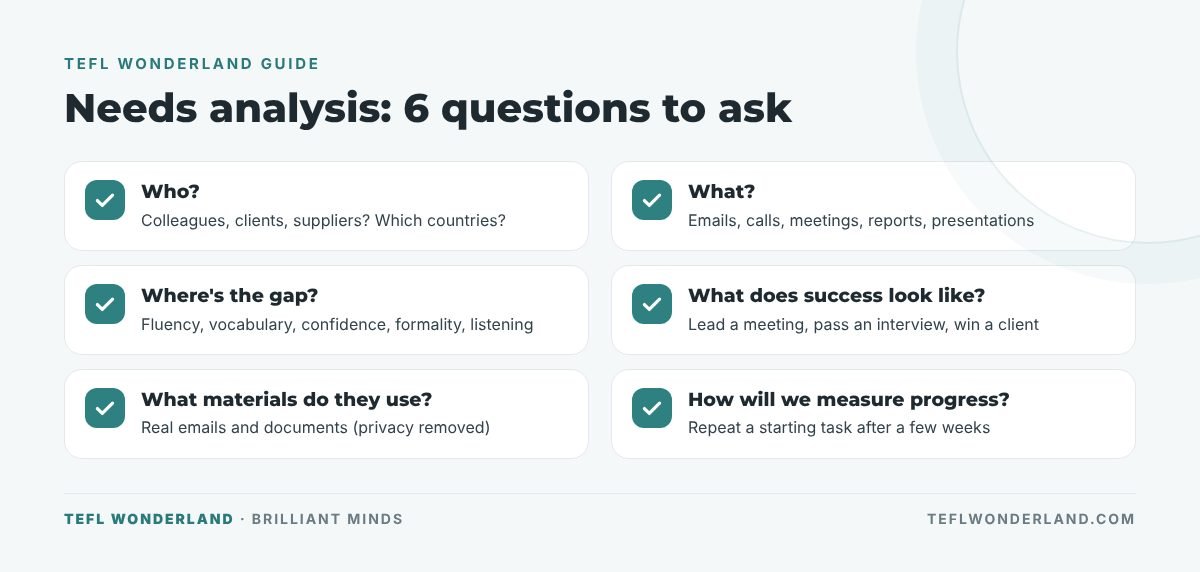
Before you plan anything, find out who your learners communicate with, what they do in English, where they struggle and what success looks like. Use a short questionnaire and a speaking task. Ask them to bring real emails or documents, with private details removed. In company courses, talk to the manager or HR contact too: their goals may be different from the learners’.
Step 2: Set clear goals
Turn the needs into goals with a level and a time frame, for example: “In 10 weeks, lead a 15-minute project update in English with confidence.” The Common European Framework of Reference (CEFR) helps you describe levels and progress clearly with “can do” statements.
Step 3: Teach the core business skills
Emails and writing
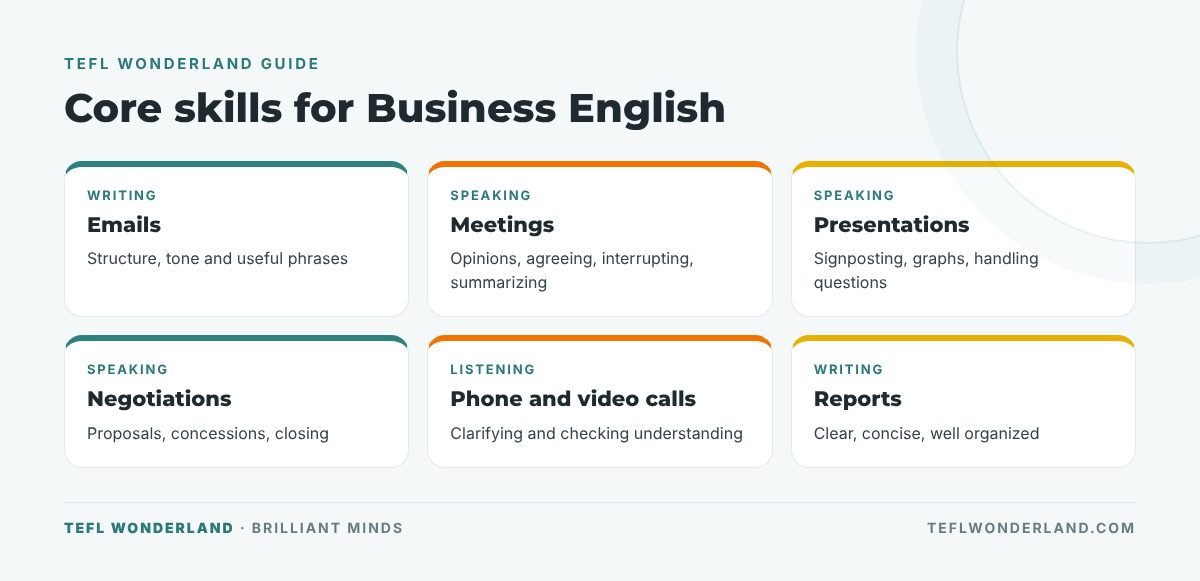
Focus on structure, tone and useful phrases: opening, purpose, request, closing. Compare a too-direct email with a polite one and ask learners to rewrite. Build a personal phrase bank for each learner.
Meetings
Practice language for giving opinions, agreeing and disagreeing politely, interrupting and summarizing. Role-play real agenda items from the learners’ own work.
Presentations
Teach signposting (“First, I’ll…”, “Moving on to…”, “To sum up…”), describing graphs and handling questions. Record practice presentations and give feedback on one or two points at a time.
Negotiations and phone calls
Use realistic scenarios and repeat them several times, adding a new challenge each time: a difficult client, a shorter deadline, a lower budget. Repetition builds fluency and confidence.
Step 4: Use authentic materials
Company websites, news articles, product brochures, annual reports and the learner’s own documents are more motivating than any coursebook. Adapt them to the learner’s level by shortening texts and pre-teaching key words.
Step 5: Measure progress
Revisit the starting task after a few weeks and show learners how far they have come. Business clients and their companies want to see results. Simple tools work well: a “before and after” recording, a CEFR self-assessment checklist and a short report for the manager.
Teaching Business English online
Most Business English lessons now happen on video calls, which is perfect practice, because so much business communication happens online too. When teaching Business English this way, use the shared screen to edit emails together, practice real meeting situations and teach the language of video calls (“Sorry, you’re on mute”, “Can everyone see my screen?”).
A sample 60-minute Business English lesson
Here is how teaching Business English can look in one lesson for a B1 sales manager:
- Warm-up (5 min): “What was your most difficult email this week?”
- Input (15 min): compare two versions of a follow-up email to a client; notice polite phrases.
- Controlled practice (10 min): rewrite direct sentences politely (“Send me the price” → “Could you send me the price list?”).
- Real task (20 min): write a real follow-up email from the learner’s own work; teacher feedback on the screen.
- Review (10 min): build a phrase bank and set a goal for next week.
Finding Business English clients
- Specialize: for example, English for engineers, healthcare or hospitality.
- Offer packages: a needs analysis plus 10 or 20 lessons with a clear goal.
- Ask for referrals: happy learners often recommend you to colleagues.
- Contact companies directly: HR departments and training managers often look for in-company teachers.
Getting started as a Business English teacher
A solid TESOL qualification gives you the methodology. Business experience helps, but it isn’t essential. What matters is curiosity about your learners’ work and well-planned, practical lessons. Our CPD course Teaching Online, Business English, Young Learners and Test Preparation (25 hours) covers the specific skills for teaching Business English and other specialist groups. Find it in our teacher development courses. If you are new to teaching, start with our TESOL courses, which include a whole zone on Teaching English for Specific Purposes.
FAQs
Do I need business experience for teaching Business English?
No, but it helps to be interested in your learners’ work. Ask questions, learn the vocabulary of their field and let them teach you about their job, which is great speaking practice for them.
Is teaching Business English better paid?
Often, yes. Companies and professionals usually pay more than general English learners, especially for one-to-one or in-company lessons.
What level do Business English learners need?
Any level. Lower-level learners focus on survival tasks like simple emails and introductions; advanced learners work on negotiations, presentations and nuance.
References and further reading
- Hutchinson, T., & Waters, A. (1987). English for Specific Purposes: A Learning-Centred Approach. Cambridge University Press.
- Frendo, E. (2005). How to Teach Business English. Pearson Longman.
- Ellis, M., & Johnson, C. (1994). Teaching Business English. Oxford University Press.
- Council of Europe. Common European Framework of Reference for Languages (CEFR). coe.int