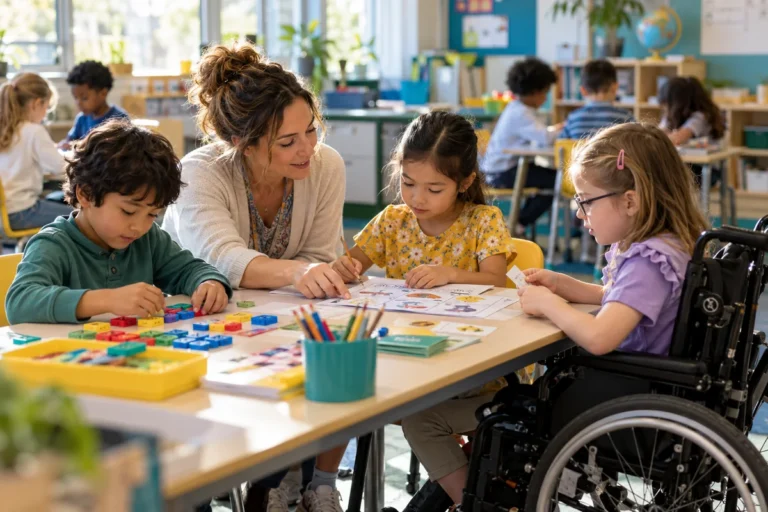

Children can be the most rewarding learners you will ever teach: curious, energetic and fearless about making mistakes. They can also be the most challenging. Teaching young learners needs different skills from teaching teenagers or adults. Here are eleven practical, research-informed tips to help your lessons run smoothly and help children love English.
Why teaching young learners is different
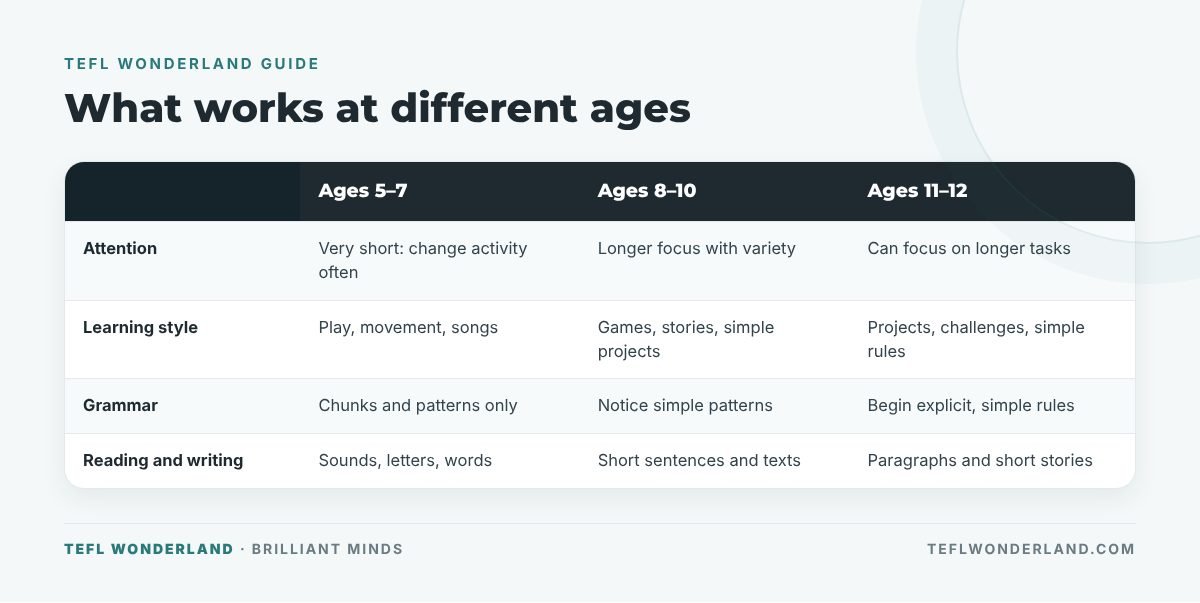
Children between 5 and 12 learn best by doing, moving, playing and repeating. Lynne Cameron, in her classic book Teaching Languages to Young Learners (2001), explains that children learn language through meaningful activity and social interaction, not through rules: they need support (scaffolding) and routines that let them participate before they can produce language on their own. Their attention span is short, they respond strongly to the teacher’s energy and warmth, and they change a lot from one year to the next.
1. Build strong routines
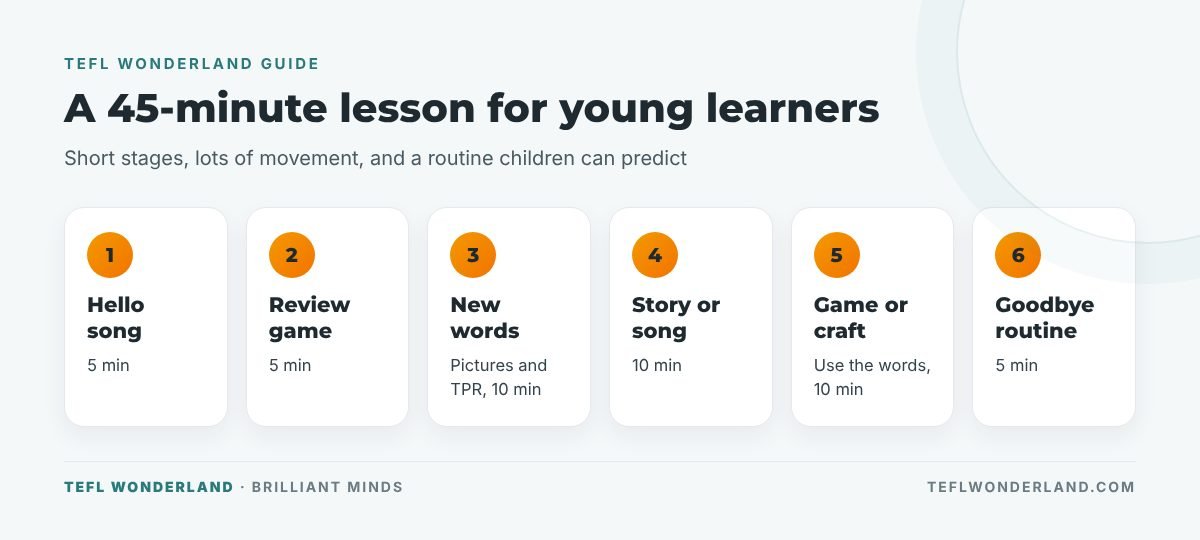
A hello song, a weather check and a goodbye game give structure and security. Children relax when they know what comes next, and routines are also great language practice: the same phrases every day become automatic.
2. Keep activities short
A useful rule of thumb is about one to two minutes of focus per year of age. Change activities often and alternate calm tasks (coloring, listening) with active ones (games, movement). Plan more activities than you think you need.
3. Use songs and chants
Songs make language memorable through rhythm and repetition. Add actions, change the words to practice new vocabulary and repeat favorite songs for weeks.
4. Use Total Physical Response (TPR)
In TPR, children respond to instructions with their bodies before they speak (“Jump!”, “Touch something blue!”, “Put the pencil under the book”). It was developed by James Asher, whose research showed that learners understand and remember commands better when they act them out (Asher, 1969). TPR builds understanding without pressure, which is ideal for shy children.
5. Bring in real objects and pictures
Flashcards, toys, puppets and real objects make meaning clear without translation. A puppet that “only speaks English” is a classic for a reason: children will talk to it when they are too shy to talk to you.
6. Teach through stories
Stories give context for vocabulary and grammar. Read with expression, pause to let children predict, ask them to join in with repeated lines and act out parts of the story.
7. Play games with a language goal
Bingo, “Simon says”, memory games and races are fun, but always link them to the target language. The game is the vehicle; English is the destination.
8. Praise effort, not just answers
Celebrate trying: “Great guess!” and “Good try in English!” build confidence. Sticker charts and class points work well with this age group, especially when you reward effort and kindness as well as correct answers.
9. Use clear, simple classroom language
Teach phrases like “Sit down, please”, “Your turn” and “Well done” in the first lessons, and use them consistently with gestures. Soon children will use them too.
10. Plan for different learners
Some children are shy, some never stop moving. Offer roles (helper, timekeeper, card holder), choices and both quiet and active tasks. Group children thoughtfully so everyone can take part.
11. Involve parents
Teaching young learners works best as a team effort. Short updates, a song to practice at home or a picture of the day’s work help parents support learning. Research summarized by the Education Endowment Foundation suggests that practical strategies for learning at home, such as shared reading, help children’s learning (EEF). The British Council’s LearnEnglish Kids is a great free site to recommend to families.
A sample week of teaching young learners
When teaching young learners, plan a theme for the week (for example, animals) and recycle the same words in different ways:
- Day 1: flashcards and TPR (“Jump like a frog!”).
- Day 2: an animal song with actions.
- Day 3: a picture story; children join in with the repeated line.
- Day 4: a guessing game (“It’s big. It’s gray. It has a long nose.”).
- Day 5: make a mini-book or poster and present it to a partner.
Correcting mistakes
With young learners, focus on meaning and confidence. Instead of stopping a child, model the correct form naturally: if a child says “I goed to the park”, reply “Oh, you went to the park! What did you see?” This kind of correction, called recasting, keeps the conversation going.
Teaching young learners online
Online lessons for children work best when they are short, very visual and interactive. Use props, movement breaks, a digital reward chart and lots of names: “Sara, show me something red!” Keep parents informed about how to help with the technology.
Resources and next steps
The British Council’s TeachingEnglish website has free activities and lesson ideas for primary classes. For structured training, our 15-hour course Teaching Young Learners covers child development, activity design and classroom management for ages 5 to 12. It is part of our teacher development courses.
If you need ready-made, gamified materials, our English courses and interactive flipbooks with audio (Explorers, Adventurers, Champions and Wizards) can be used with a classroom license through our teaching resources.
FAQs
What is the best age to start learning English?
Children can start very young, especially through songs and play. What matters most is regular, enjoyable exposure and a positive attitude.
Should I correct every mistake when teaching young learners?
No. Focus on meaning and confidence. Model the correct form naturally instead of stopping the child.
How much grammar should I teach children?
Very little explicit grammar. Children learn patterns through songs, stories and repetition. Older children (around 10 to 12) can start noticing simple rules.
References and further reading
- Cameron, L. (2001). Teaching Languages to Young Learners. Cambridge University Press.
- Asher, J. J. (1969). The total physical response approach to second language learning. The Modern Language Journal, 53(1), 3–17. doi.org/10.1111/j.1540-4781.1969.tb04552.x
- Education Endowment Foundation. Working with Parents to Support Children’s Learning. educationendowmentfoundation.org.uk
- British Council. TeachingEnglish. teachingenglish.org.uk
- British Council. LearnEnglish Kids. learnenglishkids.britishcouncil.org