

When people hear “entrepreneurship”, they often think of tech founders and start-up money. But entrepreneurship education in schools is much broader. It is about helping young people notice problems, imagine solutions, work with others, take sensible risks and learn from failure. These are skills every student needs, whether they start a business, work for an organization or lead a community project.
What is entrepreneurship education?
The European Commission’s EntreComp framework defines entrepreneurship as acting on opportunities and ideas and transforming them into value for others, where that value can be financial, cultural or social (Bacigalupo et al., 2016). In other words, a student who organizes a recycling campaign, designs an app to help classmates study or runs a charity sale is practicing entrepreneurship.
Researchers often distinguish three approaches (Lackéus, 2015):
- teaching about entrepreneurship (theory, case studies);
- teaching for entrepreneurship (preparing students to start ventures);
- teaching through entrepreneurship (learning by creating real value for real people).
The third approach is the most powerful in schools, because it combines subject learning with real-world projects.
Why it matters
Young people are entering a world of fast technological change, new kinds of jobs and global challenges. The Global Entrepreneurship Monitor, which studies entrepreneurial activity in dozens of economies every year, highlights the role of education in building the knowledge and confidence people need to act on opportunities (GEM). Entrepreneurship education also builds broader skills: creativity, communication, teamwork, financial literacy and resilience.
The EntreComp framework
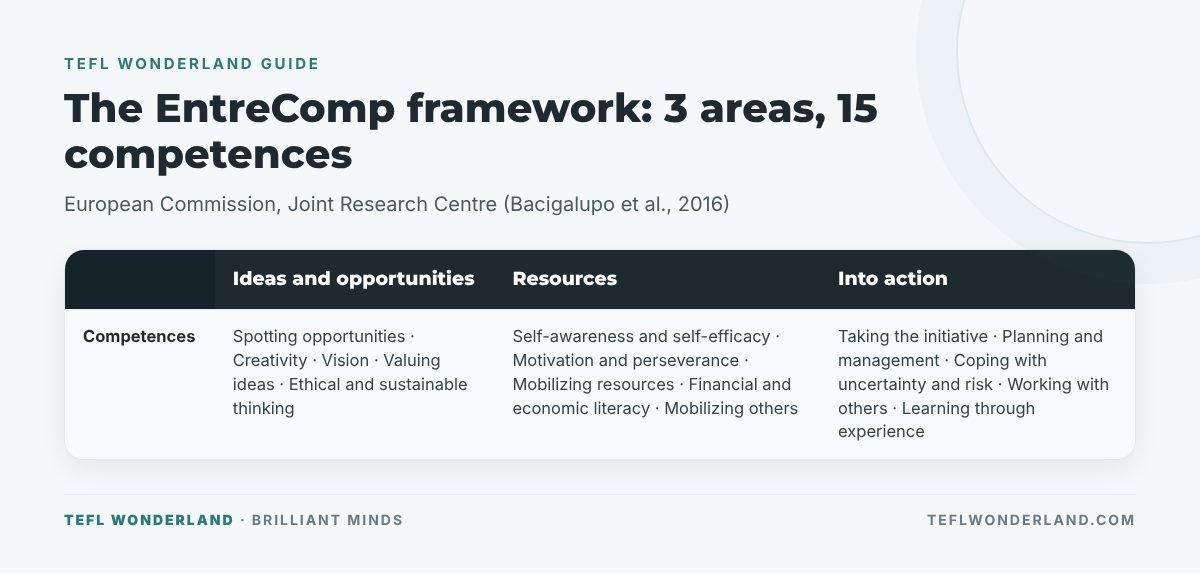
EntreComp groups 15 competences into three areas: ideas and opportunities, resources and into action. Schools can use it as a checklist when planning projects: Does this project ask students to spot an opportunity? To plan and manage resources? To work with others and cope with uncertainty? It also offers progression levels, from foundation to expert, which makes it easier to describe growth.
Practical ways to teach entrepreneurship education
Start with real problems
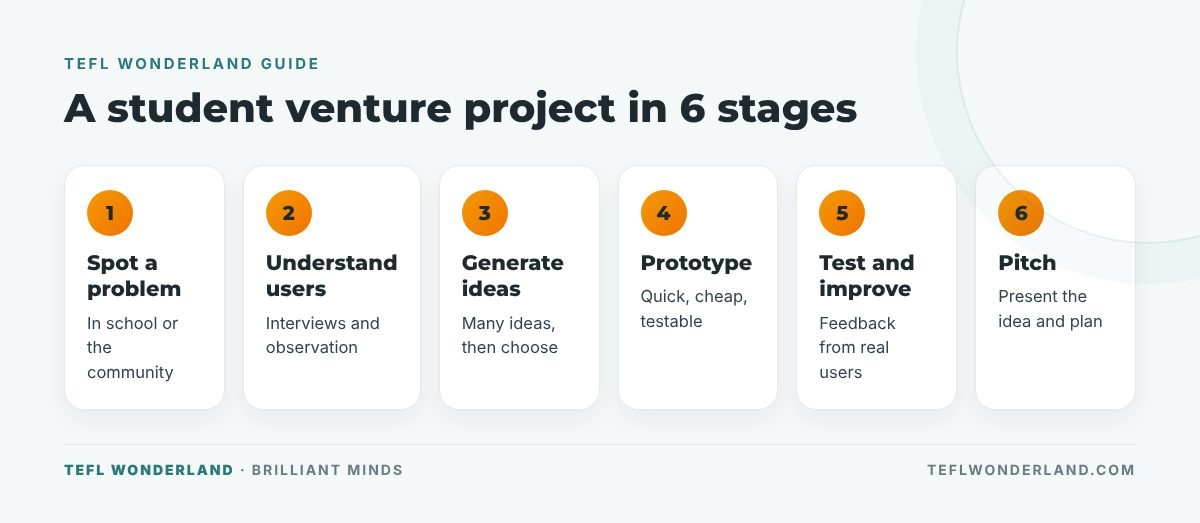
Ask students to find a problem they care about in their school or community: long lunch queues, plastic waste, lonely elderly neighbors, students who struggle with homework. Real problems create real motivation.
Use design thinking
Design thinking gives students a simple process: understand users, define the problem, generate ideas, build prototypes and test them. Stanford’s d.school has popularized this approach in education.
Build prototypes quickly
A prototype can be a drawing, a cardboard model, a simple web page or a role-play of a service. The goal is to learn quickly and cheaply what works.
Teach basic money skills
Simple budgeting, costs, pricing and the idea of value help students make realistic plans. A school fair or online shop is an excellent practice ground.
Pitch and get feedback
Pitching an idea to a panel, even a small one, builds communication and confidence. Teach a simple structure: problem, solution, who it helps, how it works, what you need.
Celebrate learning from failure
Many ideas don’t work the first time. Ask students to reflect: What did we learn? What would we change? This builds the resilience that entrepreneurs need.
Entrepreneurship education across subjects
Entrepreneurship doesn’t need its own timetable slot. English classes can practice pitches, interviews and persuasive writing; math classes can calculate costs and profits; science classes can design solutions to environmental problems; art classes can design brands and products. Teaching through real projects connects subjects in a way students remember.
Competitions as a goal
Competitions give students a deadline, an audience and a reason to do their best. Our international competition INVOPRENEUR invites young innovators to develop real projects, individually or in teams of two or three, in four categories: Spark Pioneers (middle school), Future Makers (high school), Venture Architects (university) and Venture Launchers (fresh graduates). Projects range from school and community initiatives to prototypes and early-stage startups, with mentoring and Global Finals in Egypt. For teachers and older learners who want structured training, our Entrepreneurship Program, accredited by Gatehouse Awards and the American Management Institute, covers value proposition, customer insight, business model, feasibility, scalability, and leadership and strategy.
FAQs
At what age can entrepreneurship education start?
It can start in primary school with simple projects such as a class sale or a problem-solving challenge. Older students can work on more complex ventures, business plans and pitches.
Do teachers need business experience to teach entrepreneurship?
No. Teachers need to facilitate projects, ask good questions and connect students with real users and mentors. Frameworks like EntreComp help structure the learning.
How can we assess entrepreneurship skills?
Use a mix of evidence: project portfolios, reflections, pitches, peer feedback and rubrics based on frameworks such as EntreComp.
References and further reading
- Bacigalupo, M., Kampylis, P., Punie, Y., & Van den Brande, G. (2016). EntreComp: The Entrepreneurship Competence Framework. Publications Office of the European Union. publications.jrc.ec.europa.eu
- Lackéus, M. (2015). Entrepreneurship in Education: What, Why, When, How. OECD Entrepreneurship360 Background Paper.
- Global Entrepreneurship Monitor. gemconsortium.org
- Stanford d.school. dschool.stanford.edu