

A good lesson can look effortless, but behind it there is almost always a good plan. Writing an ESL lesson plan helps you think about what students will learn, how they will practice and how you will know they’ve got it. Here is a simple five-step template, a worked example and practical tips you can use for almost any lesson.
Before you start: know your learners
Note your students’ age, level, number and interests, plus anything you know about their strengths and difficulties. A plan for ten business adults looks very different from a plan for thirty 9-year-olds. If you can, describe the level with the CEFR (A1 to C2), so your aims match what learners can realistically do.
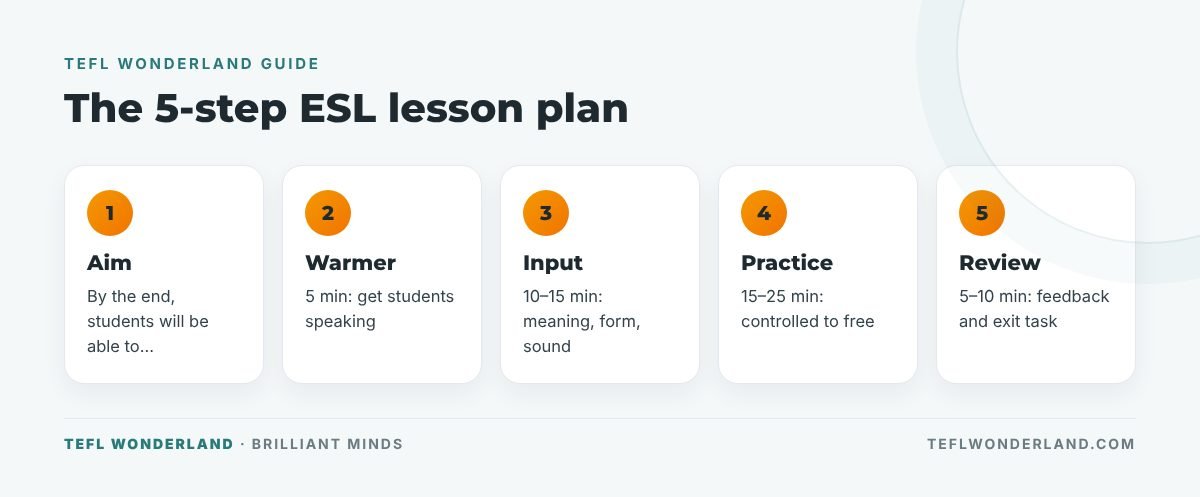
Step 1: Write a clear aim for your ESL lesson plan
Start with what students will be able to do by the end of the lesson. Make it specific, practical and observable:
- Weak aim: “Teach the past simple.”
- Strong aim: “By the end of the lesson, students will be able to talk about their last weekend using the past simple.”
A clear aim keeps your ESL lesson plan focused. Every activity should help students reach it. Verbs like describe, ask, compare and write are easier to check than understand or know, an idea that comes from Bloom’s taxonomy of learning objectives (Anderson & Krathwohl, 2001).
Step 2: Warmer (5 minutes)
Get students thinking and speaking in English. Use a picture, a question, a short game or a quick review of the last lesson. Link it to the topic if you can. A short review at the start also helps memory: research shows that recalling earlier learning strengthens it (Roediger & Karpicke, 2006).
Step 3: Input or presentation (10 to 15 minutes)
Introduce the new language or skill. Use context first: a short story, a dialogue, a video or a reading text. Then focus on:
- meaning: what does it mean, and when do we use it?
- form: how is it built?
- pronunciation: how does it sound in natural speech?
Ask concept-checking questions such as “Is this now or in the past?” to make sure students understand. Rosenshine’s Principles of Instruction recommend presenting new material in small steps and checking understanding often (Rosenshine, 2012).
Step 4: Practice (15 to 25 minutes)
Move from controlled practice to freer practice:
- Controlled: gap-fills, matching, drills. Accuracy is the focus.
- Semi-controlled: guided questions, short dialogues with prompts.
- Free: a discussion, role-play, survey or short writing task where students use the language naturally.
This is usually the longest stage of your ESL lesson plan, and the most important one. Students learn by using the language, so keep teacher talk short here.
Step 5: Review and feedback (5 to 10 minutes)
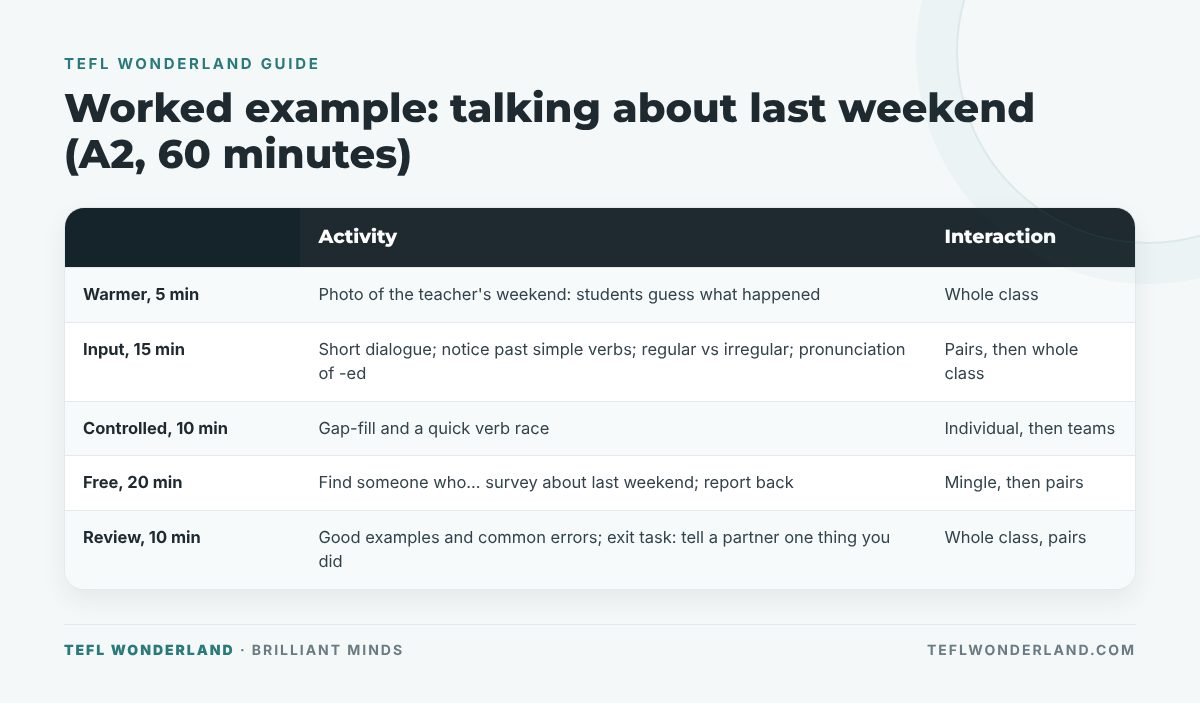
Share good examples you heard, correct common errors (without naming students) and ask learners what they learned. An exit task, such as “Tell your partner one thing you did last weekend”, shows you whether the aim was reached.
A worked example
ESL lesson plan template
You can copy this structure into any document:
- Class: level, age, number of students
- Aim: “By the end of the lesson, students will be able to…”
- Materials: texts, pictures, slides, handouts
- Stage / time / activity / interaction (teacher-student, pairs, groups)
- Anticipated problems and solutions
- Extra activity for fast finishers
- Homework
Adapting your ESL lesson plan for different levels
- Beginners (A1–A2): more visuals, shorter stages, more controlled practice and a lot of repetition.
- Intermediate (B1–B2): longer freer practice, more student-led discussion and a focus on accuracy in feedback.
- Advanced (C1–C2): authentic materials, debate, nuance and register; your ESL lesson plan can give students more control of the content.
Tips for a better ESL lesson plan
- Time everything. Add timings to each stage, and plan what to cut if you run out of time.
- Vary interaction. Mix whole-class, pair and group work.
- Plan your instructions. Write the exact words you will use for tricky activities, and an instruction-checking question.
- Expect problems. Note words or grammar students might confuse, and how you will help.
- Reflect afterwards. Write two lines: what worked and what you would change next time.
For more ideas, the British Council’s TeachingEnglish website has free lesson plans for every level.
Learn to plan with confidence
Lesson planning is a core part of our TESOL courses, with assignments marked by TEFL experts and detailed feedback. For more depth, see our 30-hour CPD courses Lesson Planning: From Explaining to Enabling and Planning Lessons and Designing Teaching Materials in our teacher development courses.
FAQs
How long should an ESL lesson plan be?
One page is enough for most lessons. What matters is a clear aim, stages with timings and the materials you need.
Should I follow my lesson plan exactly?
No. A plan is a guide. If students need more time or a different activity, adapt. Good teachers plan carefully and then respond to the class.
How long does it take to write a lesson plan?
At first, it may take an hour or more. With practice and a template like this one, most teachers plan a lesson in 15 to 30 minutes.
References and further reading
- Rosenshine, B. (2012). Principles of instruction: Research-based strategies that all teachers should know. American Educator, 36(1), 12–19, 39. aft.org
- Anderson, L. W., & Krathwohl, D. R. (Eds.). (2001). A Taxonomy for Learning, Teaching, and Assessing: A Revision of Bloom’s Taxonomy of Educational Objectives. Longman.
- Roediger, H. L., & Karpicke, J. D. (2006). Test-enhanced learning: Taking memory tests improves long-term retention. Psychological Science, 17(3), 249–255. doi.org/10.1111/j.1467-9280.2006.01693.x
- Scrivener, J. (2011). Learning Teaching: The Essential Guide to English Language Teaching (3rd ed.). Macmillan.
- Harmer, J. (2015). The Practice of English Language Teaching (5th ed.). Pearson.