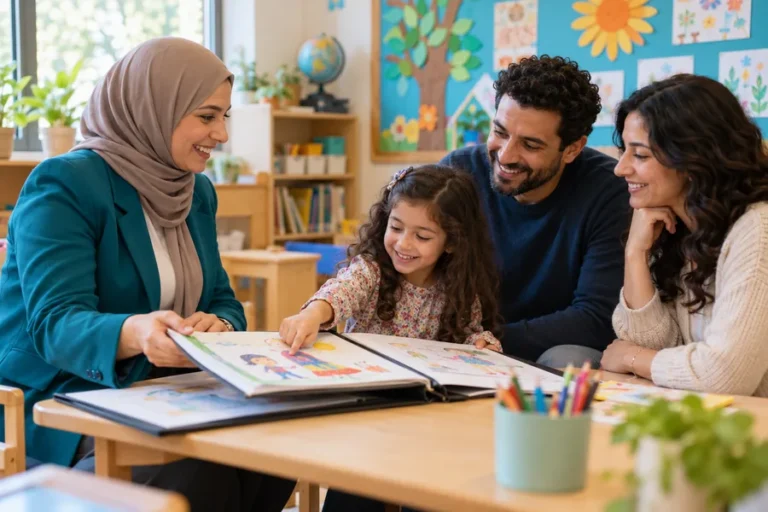

Many parents tell us the same thing: “I want to help my child with English, but my own English isn’t very good.” The good news is that you don’t need perfect English to make a big difference. What children need most is regular, enjoyable contact with the language and an adult who is interested in what they are learning. Here are ten easy ways to help your child learn English at home, plus answers to the questions parents ask us most.
Why your help matters
When you help your child learn English at home, you multiply what happens at school. Children spend far more time at home than at school. Research summarized by the Education Endowment Foundation shows that parents can support learning effectively with practical, simple strategies, especially shared reading and talking about learning (EEF). A long-term study of young children also found that shared reading at home was linked to children’s vocabulary and language development (Sénéchal & LeFevre, 2002). You don’t need to be a teacher; you need to be a partner.
10 ways to help your child learn English at home
1. Make it a little, every day
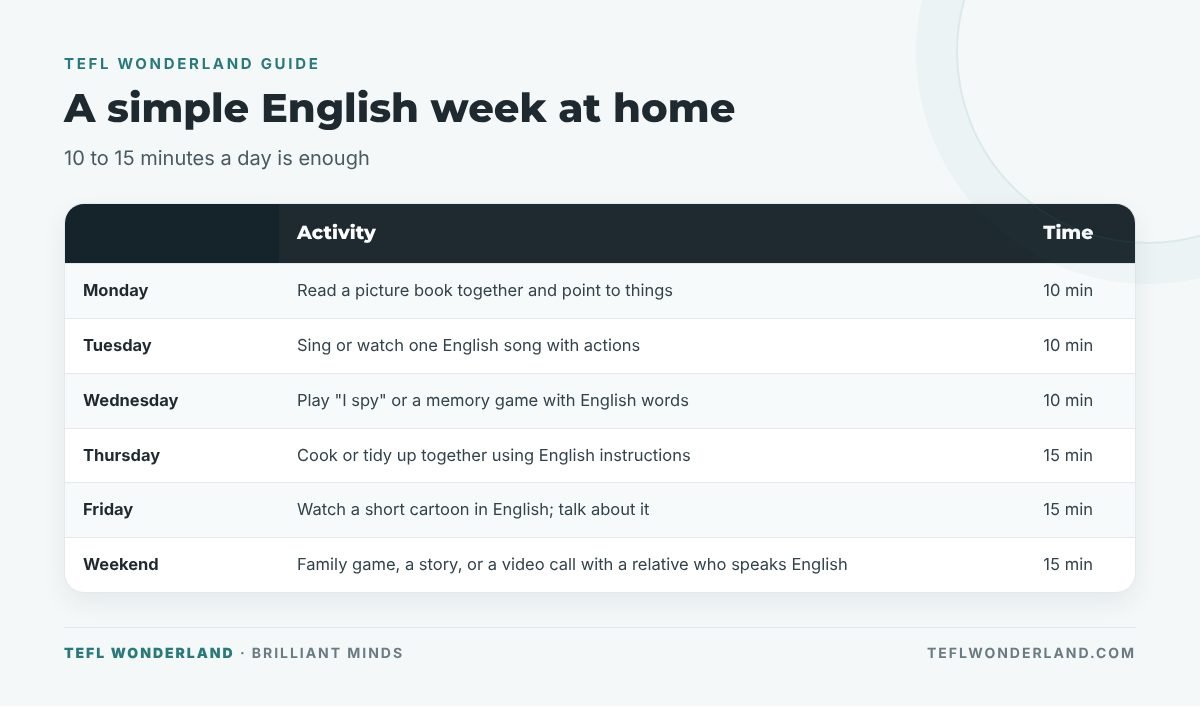
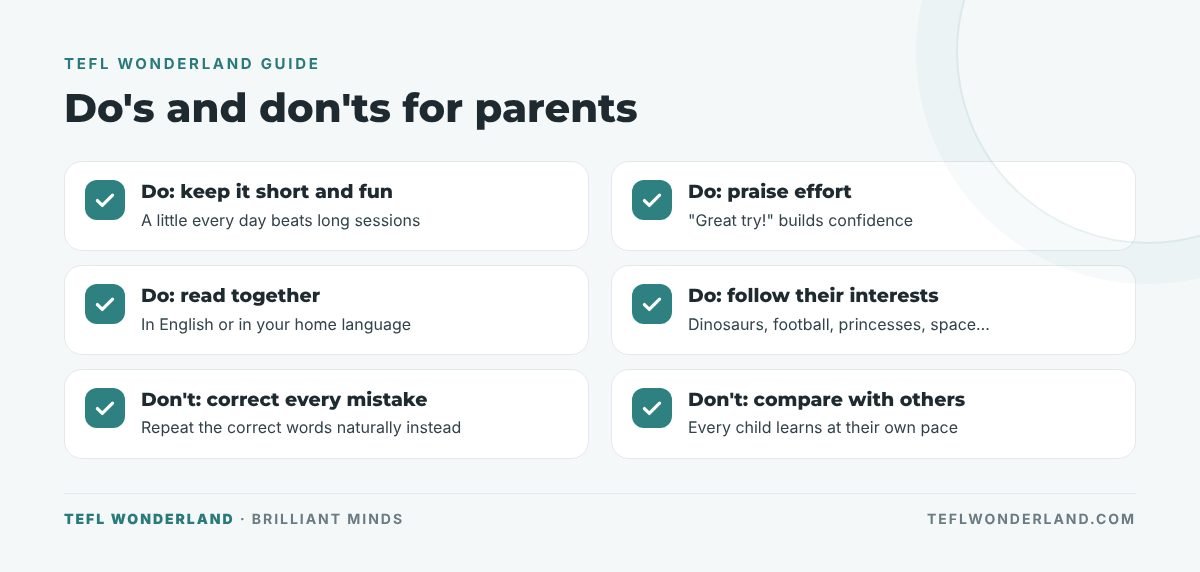
The simplest way to help your child learn English is a short daily habit. Ten to fifteen minutes a day is better than one long session a week. Short, regular practice helps memory, and it fits into busy family life.
2. Read together
Read picture books in English, or read in your home language too: strong reading skills in any language help children learn English. Point to pictures, ask “What’s this?” and let your child “read” to you from the pictures.
3. Sing songs and use rhymes
Songs and rhymes are one of the easiest ways for children to remember words and sounds. Sing in the car, at bath time or while tidying up. Add actions to make it even more memorable.
4. Play simple games
“I spy something blue”, memory games with picture cards, “Simon says” and bingo are fun and need very little English. Let your child be the teacher sometimes.
5. Use English in daily routines
Choose one routine, such as breakfast, bath time or getting dressed, and use a few English words every time: “Shoes on!”, “Let’s wash our hands.” Repetition in a real situation is how children learn their first language too.
6. Make screen time count
Choose good-quality English cartoons, songs and apps, and watch together when you can. Talk about what you watched: “Who was your favorite character?” The British Council’s LearnEnglish Kids has free songs, stories and games, with guidance for parents.
7. Follow your child’s interests
A child who loves football, dinosaurs or space will happily learn the English words for them. Find books, videos and games about what they already love.
8. Praise effort, not perfection
Celebrate every try: “Great try in English!” Children who feel safe to make mistakes speak more, and speaking more is how they improve.
9. Don’t correct every mistake
If your child says “I goed to the park”, simply answer with the correct form: “Yes, you went to the park! What did you do there?” This keeps the conversation going and still models good English.
10. Stay connected with the teacher
Ask the teacher what your child is learning this month and which words or songs you can practice at home. Share what you see at home too: you are part of the team.
What if my English is basic?
You can still help your child learn English a lot:
- Learn together. Watch, sing and play side by side; let your child teach you new words.
- Use your home language. Talking, reading and telling stories in your own language builds thinking and vocabulary that transfer to English.
- Show interest. Asking “What did you learn in English today?” tells your child that English matters.
Common questions from parents
When should I start to help my child learn English?
Children can start very young through songs, stories and play. What matters most is regular, enjoyable contact with English and a positive attitude, not starting as early as possible.
Will learning English confuse my child’s home language?
No. Many children around the world grow up with two or more languages. Keep using your home language at home; it supports your child’s identity and learning.
How do I know if my child is making progress?
Look for small signs: understanding more instructions, singing new songs, using new words, and feeling more confident. Ask the teacher about progress in terms of what your child can now do.
Ready-made, gamified English courses
If you would like more support to help your child learn English, or a clear path for your child, our English courses are gamified and designed for each age group: Explorers (Grades 1–2), Adventurers (Grades 3–4), Champions (Grades 5–8) and Wizards (Grades 9–12), each with 100 hours of learning and interactive flipbooks with audio. Children who enjoy a challenge can also take part in the WEB Olympiad, our international English competition.
References and further reading
- Education Endowment Foundation. Working with Parents to Support Children’s Learning. educationendowmentfoundation.org.uk
- Sénéchal, M., & LeFevre, J.-A. (2002). Parental involvement in the development of children’s reading skill: A five-year longitudinal study. Child Development, 73(2), 445–460.
- British Council. LearnEnglish Kids. learnenglishkids.britishcouncil.org
- Cameron, L. (2001). Teaching Languages to Young Learners. Cambridge University Press.