

Ask experienced teachers what makes a lesson work and many will say the same thing: classroom management. Even the best activity fails if students don’t understand the instructions or the room is too noisy to listen. These twelve classroom management strategies are practical, evidence-informed and designed for English classes, where learners also face a language barrier.
What the evidence says
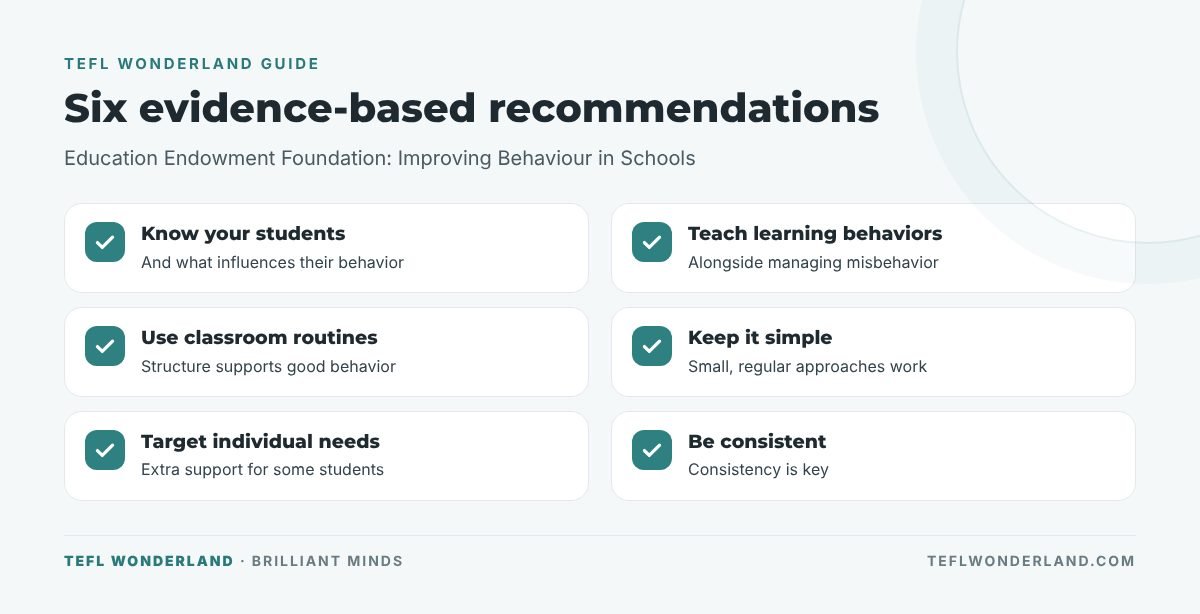
The Education Endowment Foundation (EEF) reviewed the research on behavior and made six recommendations for schools (EEF, Improving Behaviour in Schools). They are a useful frame for everything below.
Barak Rosenshine’s well-known Principles of Instruction point in the same direction: clear explanations, many examples, checking understanding and plenty of guided practice prevent many behavior problems before they start (Rosenshine, 2012).
Classroom management strategies before the lesson
1. Plan your routines
Decide how students enter, where bags go, how you start (a warmer on the board) and how you finish (a two-minute review). Teach the routines explicitly in the first lessons and practice them. Routines save time and reduce stress because everyone knows what happens next.
2. Set three or four clear rules
Agree on a few positive rules with your students: “Listen when someone speaks”, “Try in English first”, “Be kind to mistakes”. Display them and refer to them often. Positive rules describe what to do, not only what not to do.
3. Arrange the room on purpose
Horseshoes are great for discussion; pairs for practice; groups for projects. Make sure you can reach every student quickly and see every face.
During the lesson
4. Give short, clear instructions
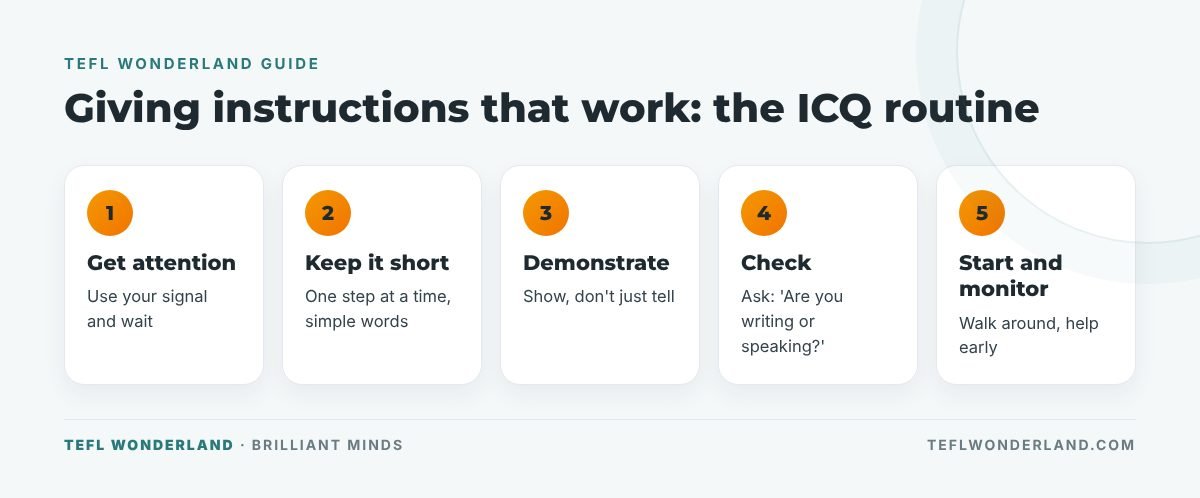
Use simple language, one step at a time, and demonstrate. Then check understanding with an instruction-checking question (ICQ) like “Are you writing or speaking?” instead of “Do you understand?”, which almost everyone answers with “yes”.
5. Use signals for attention
A raised hand, a bell or a countdown from five works better than raising your voice. Practice it in the first lesson so it becomes automatic.
6. Keep the pace lively
Change activity type every 10 to 15 minutes with young learners, and every 20 to 25 with adults. Boredom is one of the biggest causes of off-task behavior.
7. Maximize student talking time
When students are busy speaking, writing or solving problems, they have less time to misbehave. Use pair work and group tasks often, and give each student a clear role.
8. Plan for fast finishers
Keep an extra challenge ready, such as a bonus question, a word puzzle or a “teach your partner” task, so early finishers stay engaged.
Handling behavior
9. Praise specific behavior
“Great job using full sentences, Omar!” works better than “Good job”. Specific praise shows everyone what you expect.
10. Respond calmly and privately
Move closer, make eye contact or say a quiet word. Avoid public arguments; they give the behavior an audience. Use a simple, predictable sequence: reminder, warning, consequence.
11. Be consistent
Apply the same rules to everyone, every time. The EEF lists consistency as a key recommendation, and it is one of the most powerful classroom management strategies of all.
12. Build relationships
Learn names quickly, greet students at the door, ask about their interests and notice effort. Students who feel seen are more likely to cooperate.
Classroom management strategies for mixed-level classes
Mixed levels are normal in English teaching. Give the same task with different levels of support, use mixed-level pairs for speaking, and offer choice (“Write five sentences or a short paragraph”). Differentiation is not extra work when you plan it from the start.
Classroom management strategies for online classes
The same principles apply on Zoom: clear routines, short instructions, regular interaction and visible rules. Ask students to keep cameras on where possible, use breakout rooms for pair work, and use the chat or reactions for quick checks of understanding.
A first-lesson plan for classroom management
The first lesson sets the tone for the whole term. Use these classroom management strategies from day one:
- Greet every student at the door and learn names with a quick name game.
- Teach your attention signal and practice it three times in a fun way.
- Agree on three or four class rules together and write them on a poster.
- Practice two routines, for example handing out materials and moving into pairs.
- Run a short, successful activity so students leave feeling “I can do this”.
- Finish with a positive review and tell students one thing they did well as a class.
Take it further
Our 30-hour course, Strategies for Differentiation and Effective Classroom Management, goes deeper into routines, mixed-level teaching and behavior, with practical tasks you can use straight away. It is one of our teacher development courses, and it is also included free with the Premier TESOL courses through the Creative Teacher Award.
FAQs
What are the most important classroom management strategies for new teachers?
Clear routines, short instructions with demonstrations, and consistent responses to behavior are the classroom management strategies that matter most.
How do I manage a class that doesn’t speak English well?
Use gestures, pictures and demonstrations, keep instructions very short and teach classroom language (“Can you repeat, please?”) in the first lessons.
How can I stay calm when a class is difficult?
Plan your responses in advance, focus on the behavior rather than the person and remember that consistency matters more than any single moment.
References and further reading
- Education Endowment Foundation (2019). Improving Behaviour in Schools: Guidance Report. educationendowmentfoundation.org.uk
- Rosenshine, B. (2012). Principles of instruction: Research-based strategies that all teachers should know. American Educator, 36(1), 12–19, 39. aft.org
- Marzano, R. J. (2003). Classroom Management That Works: Research-Based Strategies for Every Teacher. ASCD.
- Edutopia. Classroom management. edutopia.org