
Innovation is often described as a spark of genius, but most successful innovations come from a repeatable process: understanding people’s problems, trying ideas quickly and improving them based on real feedback. Business innovation is a set of skills that students and teachers can learn and practice. This guide explains the main types of innovation and seven practical tools you can use in class or in a student competition.
What is business innovation?
Business innovation means creating new value: a new product or service, a better way of delivering it, or a new way of earning money from it. It doesn’t have to be high-tech. A school canteen that introduces pre-ordering to cut queues is innovating; so is a student who designs a simple tutoring service for younger children.
Types of innovation
- Product or service innovation: something new or much better for customers.
- Process innovation: a better, faster or cheaper way of doing something.
- Business model innovation: a new way of creating, delivering and capturing value, such as subscriptions or sharing.
- Social innovation: new solutions to social or environmental problems.
Clayton Christensen’s work on disruptive innovation showed how simpler, cheaper solutions often start at the edges of a market and grow to replace established products (Christensen, 1997). It’s a useful lens for students: you don’t need to beat the biggest company; you need to serve people who are poorly served today.
7 tools for business innovation
1. Problem interviews
Before building anything, talk to five to ten potential users. Ask about their experiences, not about your idea: “Tell me about the last time you…”. Listen for frustrations and workarounds.
2. Design thinking
Design thinking is a human-centered process: empathize, define, ideate, prototype and test. Tim Brown of IDEO described it as using a designer’s methods to match people’s needs with what is technologically feasible and viable as a business (Brown, 2008). Stanford’s d.school offers many free resources for educators.
3. “How might we…?” questions
Turn problems into opportunity questions: “How might we reduce food waste in our school canteen?” These questions invite many ideas without judging them too early.
4. Brainstorming rules
Aim for quantity first, build on others’ ideas, welcome wild ideas and delay judgment. Then vote, group similar ideas and choose one or two to test.
5. The Business Model Canvas
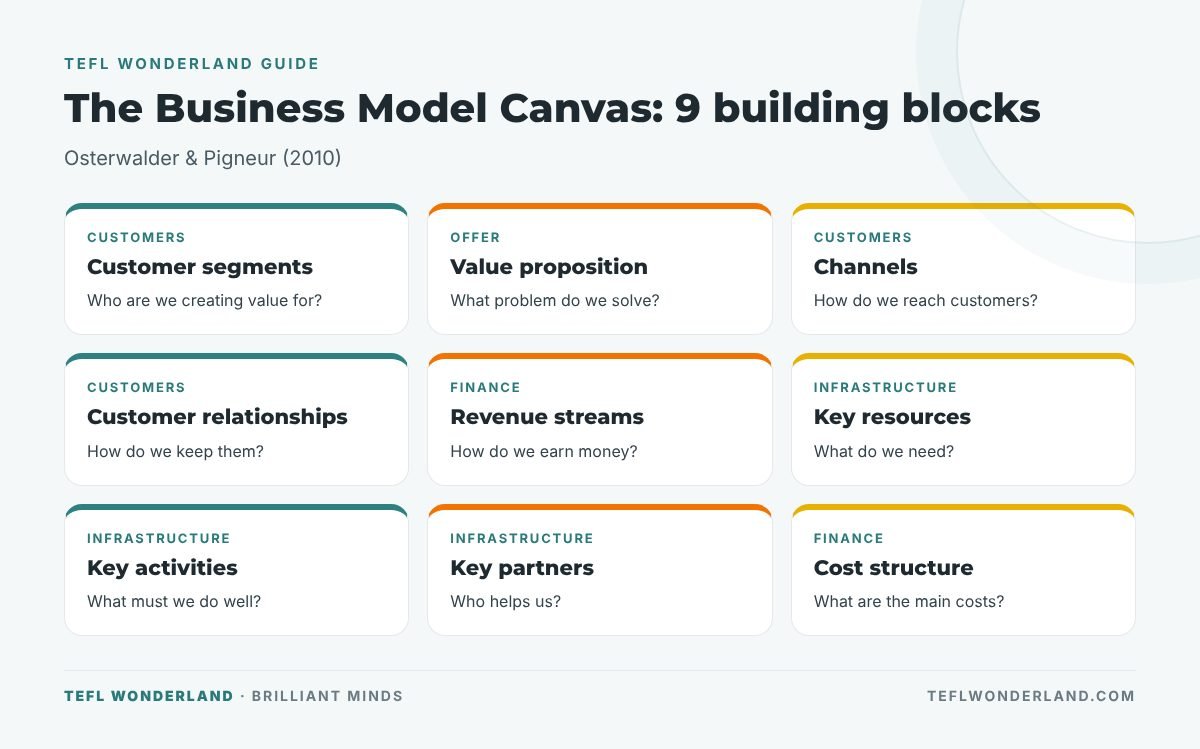
The Business Model Canvas, created by Alexander Osterwalder and Yves Pigneur, describes a business on one page in nine building blocks (Osterwalder & Pigneur, 2010). It is a great tool for student teams, because it makes them think about customers, value, costs and revenue together.
6. Build, measure, learn
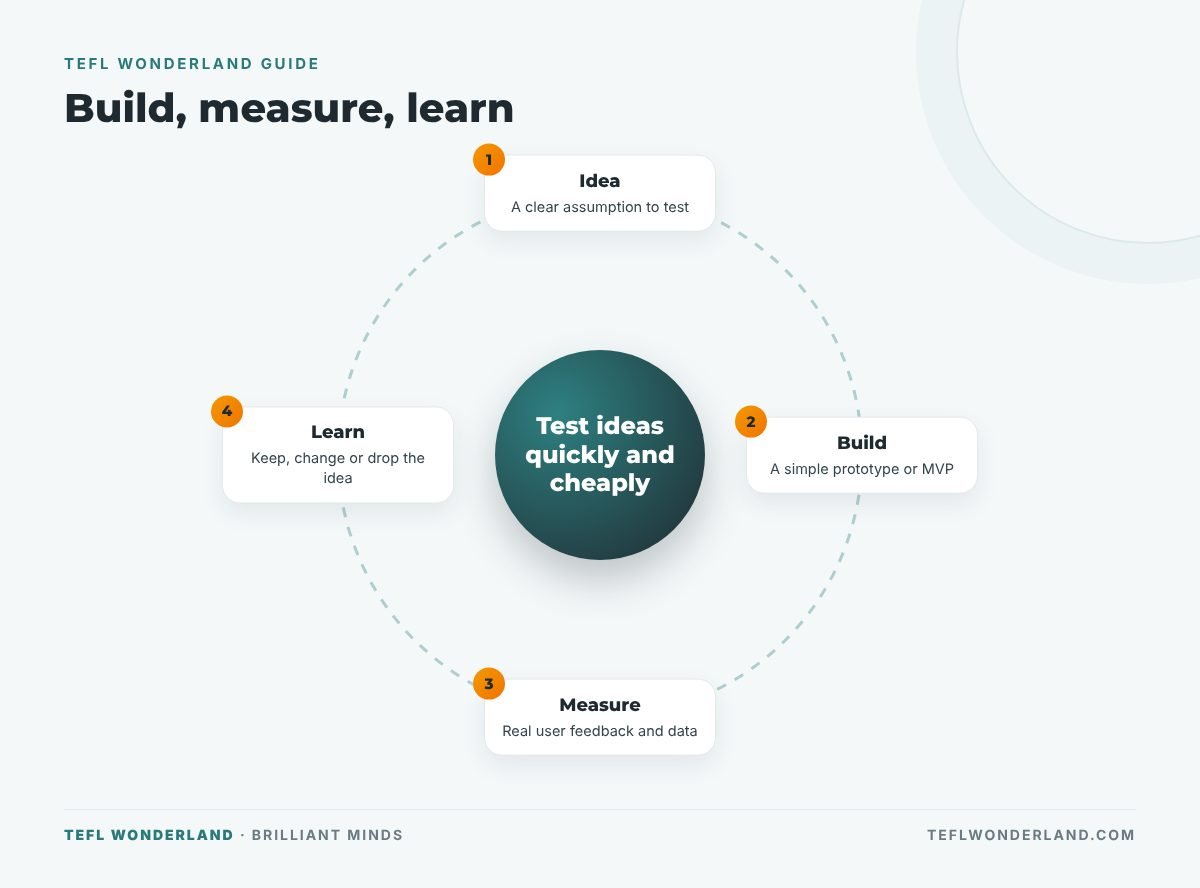
Eric Ries’s The Lean Startup popularized the build-measure-learn loop: turn your idea into a simple test (a minimum viable product), measure how real people respond, and decide whether to keep, change or drop it (Ries, 2011). For students, an MVP can be a poster, a sign-up form or a one-day pilot.
7. The pitch
A clear pitch explains the problem, the solution, who it helps, why it is different, how it will work and what you need. Practice a one-minute version and a three-minute version, and invite tough questions.
Teaching business innovation in class
- Start small: a one-week “innovation sprint” on a school problem works well.
- Mix teams: combine students with different strengths.
- Make it real: invite local business owners or parents as mentors and judges.
- Reflect: ask what students learned about people, teamwork and themselves.
- Use English: for language learners, innovation projects are full of authentic speaking, writing and presenting practice.
From classroom to competition
Our INVOPRENEUR competition gives young innovators a real stage for business innovation, individually or in teams of two or three, from Spark Pioneers (middle school) and Future Makers (high school) to Venture Architects (university) and Venture Launchers (fresh graduates), with eight innovation tracks such as AI and emerging technologies. Our Entrepreneurship Program, accredited by Gatehouse Awards and the American Management Institute, takes participants through value proposition, customer insight, business model, feasibility and scalability, whether or not they already have an idea.
FAQs
Is business innovation only for students who want to start a company?
No. Innovation skills, such as problem solving, creativity, testing ideas and teamwork, are valuable in any job and in community projects.
How long should a student innovation project take?
Short sprints of a few days teach the process; longer projects of six to ten weeks let students test ideas properly with real users.
What is the difference between innovation and invention?
An invention is a new idea or device. An innovation is a new idea that creates value for people in practice.
References and further reading
- Osterwalder, A., & Pigneur, Y. (2010). Business Model Generation. Wiley.
- Ries, E. (2011). The Lean Startup. Crown Business.
- Christensen, C. M. (1997). The Innovator’s Dilemma. Harvard Business School Press.
- Brown, T. (2008). Design thinking. Harvard Business Review, 86(6), 84–92.
- Stanford d.school. dschool.stanford.edu